AI Search Optimization Checklist 2026: The Complete Guide to Ranking in ChatGPT, Google AI Overviews, Gemini, and Perplexity
Artificial Intelligence is transforming how people discover information online. Instead of clicking through multiple search results, users increasingly rely on AI-powered search platforms such as ChatGPT, Google AI Overviews, Perplexity AI, Gemini, and Microsoft Copilot.
For publishers, marketers, and SEO professionals, this shift means that traditional SEO alone is no longer enough. To remain visible in 2026, websites must optimize not only for search engines but also for AI systems that summarize, cite, and recommend content.
This comprehensive AI Search Optimization Checklist provides a step-by-step framework to improve your visibility across AI-powered search experiences.
What Is AI Search Optimization?
AI Search Optimization is the process of improving your content so AI systems can easily understand, trust, cite, and recommend it.
Unlike traditional SEO, which focuses primarily on rankings, AI optimization focuses on:
- Citation potential
- Answer quality
- Content structure
- Entity recognition
- Topical authority
- Trustworthiness
- Original research
The goal is to become a source that AI platforms regularly reference when generating answers.
Why AI Search Optimization Matters in 2026
AI search platforms are rapidly becoming a primary method of information discovery.
Businesses that appear in AI-generated answers benefit from:
- Increased brand visibility
- More qualified traffic
- Higher authority signals
- Better trust from users
- Greater competitive advantage
As AI-generated search experiences continue expanding, citation visibility may become as important as traditional rankings.
Content Creation Checklist
1. Create Answer-First Content
AI systems prioritize content that answers questions immediately.
Before publishing, ensure that:
- The primary answer appears within the first 50 words.
- The introduction directly addresses user intent.
- Answers are concise and easy to extract.
- Important information appears near the top of the page.
- Readers can understand the main point without scrolling extensively.
Example:
Instead of writing a long introduction, answer the question first and expand afterward.
2. Structure Content Clearly
Content organization significantly affects AI extraction.
Use:
- One H1 heading
- Logical H2 and H3 sections
- Short paragraphs
- Numbered lists
- Bullet points
- Comparison tables
- FAQ sections
Well-structured content is easier for AI systems to interpret and cite.
3. Publish Original Research
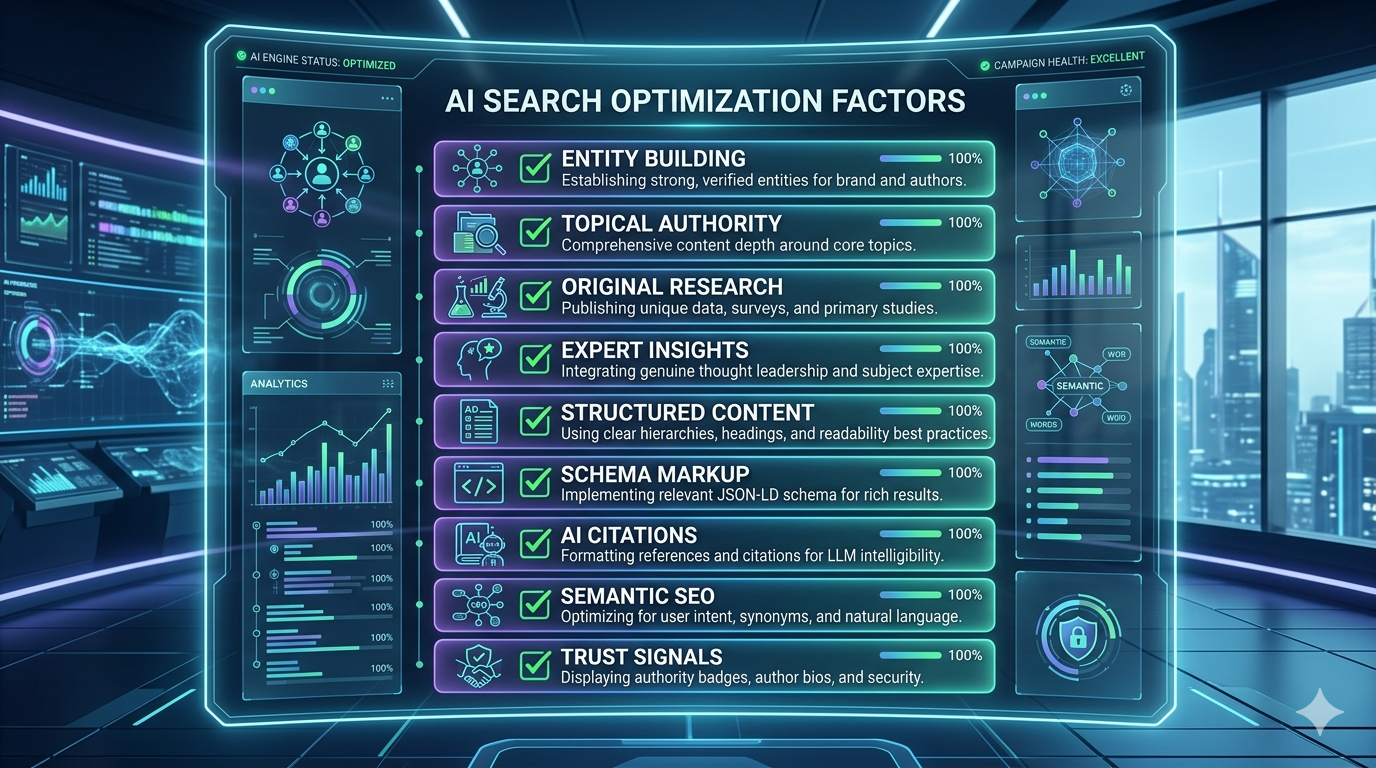
Original information is one of the strongest AI citation signals.
Consider publishing:
- Industry surveys
- Case studies
- Experiments
- Proprietary datasets
- Benchmark reports
- Trend analysis
AI systems often prioritize unique information that cannot be found elsewhere.
4. Demonstrate Real Expertise
Content should demonstrate genuine experience.
Include:
- Real examples
- Screenshots
- Testing results
- Personal observations
- Practical recommendations
Experience-based content strengthens credibility and improves citation potential.
Technical SEO Checklist for AI Search
Ensure AI Crawlers Can Access Content
Your content must be crawlable.
Verify that:
- Robots.txt allows access.
- Important pages are indexable.
- Content is publicly accessible.
- XML sitemaps are submitted.
- Canonical tags are implemented correctly.
- Internal links support discovery.
Blocked or inaccessible content cannot be cited by AI systems.
Implement Structured Data
Schema markup helps AI systems understand page context.
Recommended schema types include:
- Article
- FAQ
- Organization
- Person
- BreadcrumbList
- Product
- Review
- HowTo
Structured data provides additional signals about content meaning and relationships.
Improve Page Speed
Fast websites improve both user experience and search visibility.
Focus on:
- Core Web Vitals
- Image optimization
- Lazy loading
- CDN implementation
- JavaScript optimization
- Server response improvements
Performance remains an important ranking and user experience factor.
Content Optimization Checklist
Build Comprehensive Topic Clusters
Instead of publishing isolated articles, create interconnected content.
For example, an AI SEO cluster might include:
- AI Search Optimization
- GEO Optimization
- AI Citations
- Entity SEO
- AI Overviews
- ChatGPT SEO
- Perplexity Optimization
- LLM Optimization
Topic clusters strengthen topical authority and improve discoverability.
Optimize for Search Intent
Match content to user expectations.
Common intents include:
- Informational
- Commercial investigation
- Navigational
- Transactional
Content that aligns with search intent performs better across both traditional and AI search systems.
Improve Readability
AI systems favor content that is easy to process.
Best practices include:
- Short sentences
- Clear language
- Active voice
- Logical transitions
- Scannable formatting
Readable content benefits both humans and AI models.
Authority Building Checklist
Strengthen Brand Signals
Brands are cited more frequently than unknown websites.
Focus on:
- Consistent publishing
- Media mentions
- Social proof
- Industry recognition
- Expert contributions
- Community engagement
Strong brand authority improves trust and citation likelihood.
Build High-Quality Backlinks
Backlinks continue to influence authority.
Prioritize:
- Editorial links
- Digital PR campaigns
- Industry publications
- Guest contributions
- Research citations
Authority remains a critical factor in AI visibility.
Establish Author Credibility
Every article should clearly identify its author.
Include:
- Author bio
- Expertise information
- Relevant experience
- Social profiles
- Published work
Author transparency strengthens trust signals.
Platform-Specific Optimization
ChatGPT Optimization
To improve ChatGPT visibility:
- Publish original information.
- Create answer-first content.
- Build authority within your niche.
- Maintain content freshness.
- Develop comprehensive topic coverage.
Google AI Overviews Optimization
For Google AI Overviews:
- Target informational queries.
- Use concise definitions.
- Structure answers clearly.
- Add supporting data.
- Optimize for featured snippets.
Perplexity AI Optimization
Perplexity frequently cites sources directly.
To improve visibility:
- Publish factual content.
- Include references.
- Provide original insights.
- Maintain strong credibility signals.
Gemini and Copilot Optimization
Focus on:
- Entity recognition
- Structured content
- Comprehensive coverage
- Strong expertise signals
These platforms increasingly rely on authoritative sources.
Measuring AI Search Performance
Tracking AI visibility is essential.
Monitor:
- Organic traffic trends
- AI citation appearances
- Brand mentions
- Keyword rankings
- Conversion rates
- Referral traffic
- Engagement metrics
Use tools such as:
- Google Analytics 4
- Google Search Console
- Ahrefs
- Semrush
- Citation tracking platforms
Common AI Search Optimization Mistakes
Many websites fail because they:
- Publish generic content
- Ignore topical authority
- Skip schema markup
- Neglect content updates
- Focus only on keywords
- Lack original research
- Provide weak expertise signals
Avoiding these mistakes can dramatically improve AI visibility.
Final AI Search Optimization Checklist
Before publishing any article, confirm that it:
✔ Answers the main question immediately
✔ Uses clear heading hierarchy
✔ Includes original insights
✔ Demonstrates expertise
✔ Implements structured data
✔ Loads quickly
✔ Supports topical authority
✔ Includes trustworthy sources
✔ Is optimized for search intent
✔ Provides unique value beyond AI summaries
Conclusion
AI Search Optimization is no longer optional. As platforms like ChatGPT, Google AI Overviews, Gemini, Perplexity, and Microsoft Copilot continue reshaping search behavior, publishers must adapt their content strategies accordingly.
The websites that succeed in 2026 will be those that combine traditional SEO principles with authority building, original research, entity optimization, and AI-friendly content structures. By following this checklist consistently, you can increase your chances of being cited, recommended, and discovered across the growing ecosystem of AI-powered search engines.