How to Track Link Building ROI: A Complete Guide
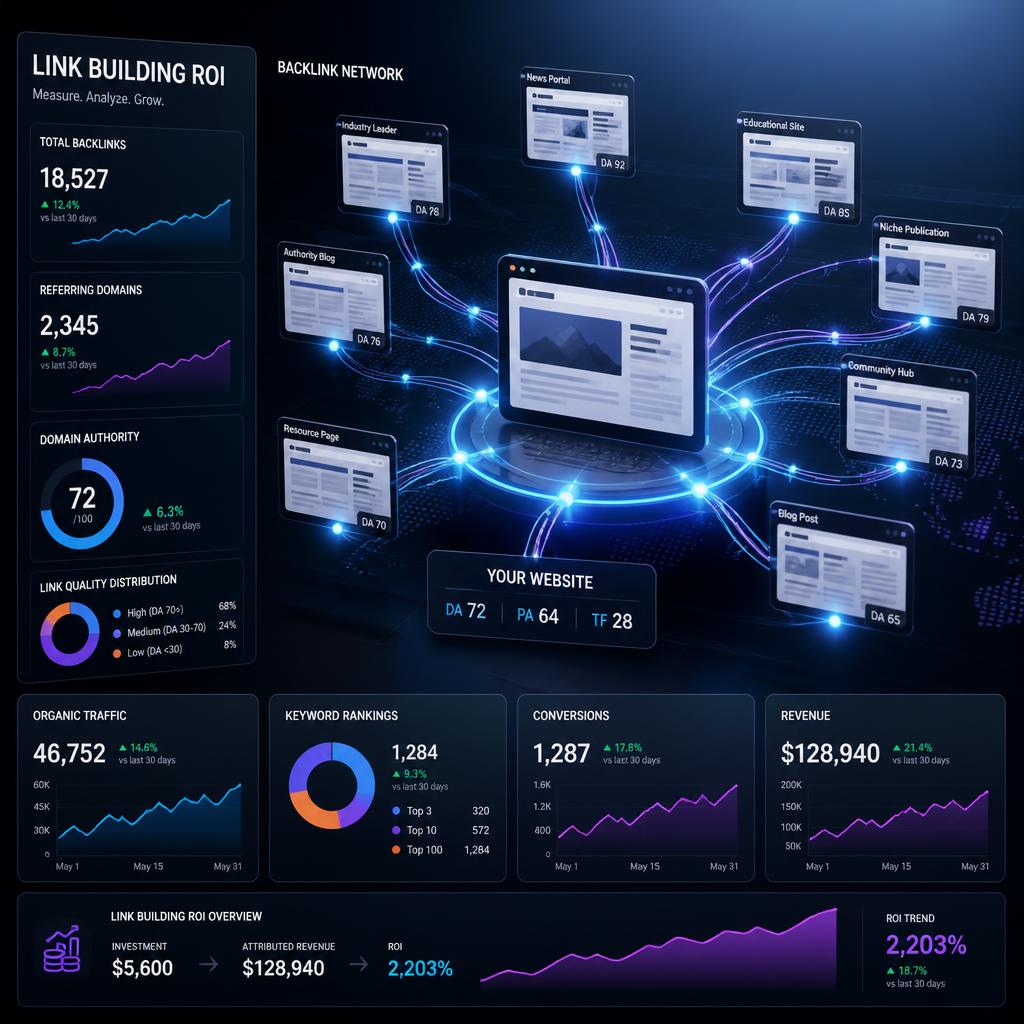
Link building remains one of the most important parts of a successful SEO strategy. Earning high-quality backlinks can help improve search visibility, increase referral traffic, strengthen website authority, and support higher rankings for valuable keywords. However, link building also requires time, resources, and often a significant financial investment.
That makes one question especially important: How do you track link building ROI?
Tracking link building ROI allows you to understand whether your backlink campaigns are producing measurable business results. Instead of focusing only on the number of links acquired, you can evaluate how those links contribute to rankings, organic traffic, leads, conversions, and revenue.
This guide explains how to measure link building ROI, which SEO metrics matter most, how to calculate your return, which tools to use, and how to build a practical reporting system.
What Is Link Building ROI?
Link building ROI, or return on investment, measures the financial value generated by your link building activities compared with the cost of acquiring those links.
The basic ROI formula is:
Link Building ROI = (Revenue Generated − Link Building Cost) ÷ Link Building Cost × 100
For example, suppose you spend $3,000 on a link building campaign and the campaign contributes $7,500 in attributable revenue.
Your ROI would be:
($7,500 − $3,000) ÷ $3,000 × 100 = 150%
This means the campaign generated a return of 150% relative to its cost.
However, SEO attribution is not always straightforward. A backlink rarely produces revenue by itself. It can influence rankings, bring referral visitors, increase brand exposure, and contribute to conversions over a period of weeks or months.
For that reason, effective link building ROI tracking should combine financial metrics with SEO performance indicators.
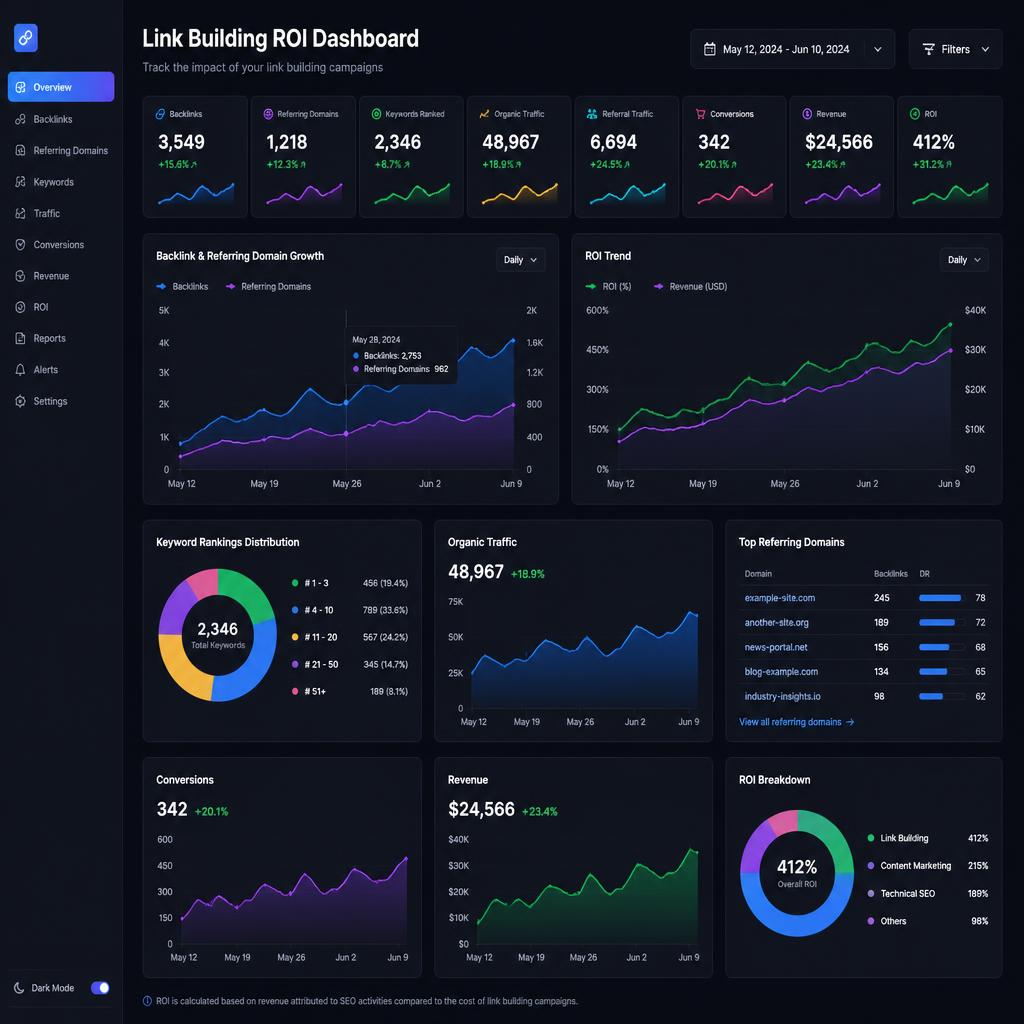
Why Tracking Link Building ROI Matters
Many businesses measure link building success simply by counting backlinks. While backlinks are important, the number of links alone does not tell you whether your campaign is delivering business value.
A campaign that earns 50 highly relevant links may be more valuable than one that produces hundreds of low-quality links.
Tracking ROI helps you:
- Identify the link building tactics producing the strongest results
- Understand which websites and campaigns generate valuable traffic
- Measure changes in organic visibility
- Connect SEO improvements with business outcomes
- Determine whether link acquisition costs are justified
- Allocate your SEO budget more effectively
- Identify campaigns that need improvement
- Demonstrate SEO performance to clients and stakeholders
The goal is not simply to acquire more backlinks. The goal is to acquire backlinks that contribute to meaningful outcomes.
The Most Important Metrics for Measuring Link Building ROI
A strong link building measurement system should track several metrics rather than relying on a single number.
1. Number of New Backlinks
The first metric to monitor is the number of new backlinks acquired during a specific period.
Track:
- New referring domains
- New backlinks
- Lost backlinks
- Links acquired per campaign
- Links by page
- Links by industry or topic
- Links by source
However, avoid treating every backlink as equally valuable. A link from a relevant, established website can have substantially more strategic value than a link from an unrelated or low-quality website.
2. Referring Domains
Referring domains can be more useful than simply counting backlinks.
For example, 100 backlinks from five websites do not necessarily provide the same value as 20 backlinks from 20 different relevant domains.
Monitor:
- Total referring domains
- New referring domains
- Relevant referring domains
- Authority and reputation of referring domains
- Growth of referring domains over time
A diversified backlink profile can provide broader exposure and potentially support stronger organic visibility.
3. Keyword Rankings
Keyword rankings are one of the most important indicators of whether your SEO efforts are improving search visibility.
Before starting a link building campaign, record the rankings of your target keywords.
Then monitor:
- Current ranking position
- Ranking changes
- Keywords entering the top 100
- Keywords entering the top 20
- Keywords entering the top 10
- Keywords reaching the top three positions
- Changes in visibility for priority pages
For example, if an important page moves from position 18 to position 7 after acquiring relevant backlinks and making other SEO improvements, that change may indicate that the campaign contributed to improved visibility.
Still, rankings should not be attributed to backlinks alone because technical SEO, content updates, search intent, competition, and algorithm changes can also affect rankings.
4. Organic Traffic
Organic traffic is another critical metric.
Use your analytics platform to monitor:
- Total organic sessions
- Organic users
- Organic landing pages
- Organic traffic to link-building target pages
- Traffic growth before and after campaigns
- Organic traffic by country
- Organic traffic by device
The most useful analysis often focuses on the specific pages targeted by your link building campaign.
If a page receives links and subsequently experiences sustained growth in organic impressions, clicks, and traffic, that provides stronger evidence of SEO impact.
5. Referral Traffic
Not every valuable backlink needs to improve rankings.
A backlink can also generate direct referral traffic.
For each important referring website, monitor:
- Referral users
- Referral sessions
- Engagement
- Pages per session
- Conversions
- Revenue
- Assisted conversions
This is particularly important when earning links from publications, industry websites, communities, and websites with an audience that matches your target customers.
A link that sends 100 qualified visitors who generate leads may be more valuable to a business than a link that produces no visitors but looks impressive in a backlink report.
How to Earn Editorial Backlinks
High-Quality Backlinks 2026: New Standards
Competitor Backlink Analysis Tutorial
6. Conversions and Leads
Ultimately, SEO exists to support business objectives.
Depending on your website, conversions may include:
- Purchases
- Contact form submissions
- Phone calls
- Newsletter registrations
- Account registrations
- Demo requests
- Free trials
- Downloads
- Affiliate clicks
Track whether organic traffic produces these actions.
For example, imagine your website receives an additional 10,000 organic visitors after a successful SEO campaign. If those visitors produce 300 leads and 30 customers, the campaign has measurable business value.
7. Revenue From Organic Search
For ecommerce websites, revenue is one of the clearest metrics.
Track:
- Organic revenue
- Revenue per organic visitor
- Average order value
- Organic conversion rate
- Revenue by landing page
- Revenue by product category
For lead-generation businesses, you may need to assign a monetary value to leads.
For example, if your average qualified lead is worth $200 and organic search generates 50 additional qualified leads, the estimated value is:
50 × $200 = $10,000
This value can then be compared with the cost of your SEO and link building activities.
How to Track Link Building ROI Step by Step
Step 1: Define Your Business Goals
Start by identifying what you want your link building campaign to accomplish.
Your goals could include:
- Increase organic traffic
- Improve rankings
- Generate leads
- Increase ecommerce revenue
- Improve visibility for commercial keywords
- Promote specific product or service pages
- Increase referral traffic
Without clear goals, it becomes difficult to determine whether a campaign was successful.
Step 2: Establish a Baseline
Record your performance before acquiring new links.
Your baseline should include:
- Existing referring domains
- Total backlinks
- Organic traffic
- Organic conversions
- Revenue from organic search
- Target keyword rankings
- Search impressions
- Search clicks
A baseline gives you something to compare against later.
For example:
| Metric | Before Campaign | After Campaign |
|---|---|---|
| Referring Domains | 180 | 235 |
| Organic Traffic | 20,000 | 27,500 |
| Top 10 Keywords | 42 | 68 |
| Organic Leads | 120 | 175 |
| Organic Revenue | $18,000 | $27,000 |
The table does not prove that backlinks alone caused every improvement, but it provides a useful framework for evaluating overall performance.
Step 3: Track Every Link Building Campaign
Do not combine every backlink campaign into one measurement bucket.
Create separate records for campaigns such as:
- Guest posting
- Digital PR
- Linkable assets
- Resource page outreach
- Broken link building
- Competitor backlink campaigns
- Editorial outreach
- Industry partnerships
For each campaign, record the date, cost, target pages, acquired links, referring domains, and subsequent performance.
This makes it easier to identify which strategies are producing meaningful results.
Step 4: Monitor Backlinks
Use an SEO platform such as Ahrefs or Semrush to monitor your backlink profile.
Track when links are:
- Discovered
- Live
- Lost
- Redirected
- Changed
- Pointing to different pages
Pay particular attention to links from relevant websites and authoritative publications.
You should also evaluate the context of the link, including the page topic, anchor text, placement, and whether the link is editorially relevant.
Step 5: Monitor Search Performance
Use Google Search Console to monitor changes in:
- Impressions
- Clicks
- Average position
- Click-through rate
- Search queries
- Landing pages
Compare performance before and after your link building campaigns.
For more detailed rank tracking, dedicated SEO platforms can monitor target keywords at regular intervals.
Step 6: Measure Referral Traffic
Analytics tools can show whether backlinks are sending visitors to your website.
Create a list of important referring domains and monitor their traffic.
A useful report could include:
| Referring Domain | Visitors | Leads | Revenue |
|---|---|---|---|
| Website A | 450 | 18 | $1,800 |
| Website B | 280 | 9 | $900 |
| Website C | 120 | 6 | $650 |
This allows you to identify backlinks that generate direct business value.
Step 7: Track Conversions
Configure conversion tracking before evaluating ROI.
For ecommerce websites, track transactions and revenue.
For lead-generation websites, track actions such as:
- Forms
- Calls
- Bookings
- Emails
- Demo requests
Whenever possible, connect these conversions to their original traffic source and landing page.
Step 8: Calculate the Total Cost
Your link building cost is more than the amount paid for placements.
Include:
- Outreach software
- SEO tools
- Content creation
- Writer fees
- Digital PR costs
- Agency fees
- Freelancer costs
- Internal employee time
- Link acquisition expenses
For example:
Content: $1,000
Outreach: $500
SEO tools: $300
Internal labor: $700
Other expenses: $500
Total campaign cost = $3,000
Using a complete cost figure gives you a more realistic ROI calculation.

How to Calculate Link Building ROI
Suppose a company spends $5,000 on link building.
After several months, organic search and related SEO improvements contribute an estimated $14,000 in additional revenue.
The calculation is:
ROI = ($14,000 − $5,000) ÷ $5,000 × 100
ROI = 180%
However, attribution deserves careful consideration.
SEO is usually a multi-channel process. A customer may first discover your brand through organic search, return through direct traffic, and eventually convert after an email or paid campaign.
Therefore, avoid claiming that every dollar of additional organic revenue was caused exclusively by backlinks.
Instead, use attribution models and supporting SEO evidence to estimate the campaign’s contribution.
How Long Does It Take to See Link Building ROI?
Link building ROI usually takes time to evaluate.
Some backlinks may generate referral traffic immediately, while ranking improvements can take considerably longer.
Factors affecting the timeline include:
- Website authority
- Competition
- Search intent
- Content quality
- Link relevance
- Number of referring domains
- Existing rankings
- Technical SEO
- Search engine changes
Instead of evaluating a campaign after only a few days, monitor performance over multiple months.
A useful reporting schedule might include:
30 days: backlink acquisition and early referral traffic
60–90 days: ranking and search visibility changes
3–6 months: organic traffic and conversion trends
6–12 months: broader business impact and long-term ROI
These are measurement windows rather than guarantees. SEO performance varies significantly between websites and industries.
Tools for Tracking Link Building ROI
Ahrefs
Ahrefs can help monitor backlinks, referring domains, organic keywords, and competing websites.
Semrush
Semrush provides backlink analysis, keyword tracking, competitor research, and broader SEO reporting.
Google Analytics
Google Analytics can be used to analyze website traffic, user behavior, conversions, and revenue.
Google Search Console
Google Search Console provides search performance data, including clicks, impressions, queries, and average search position.
Rank Tracking Platforms
Tools such as SE Ranking, AccuRanker, and other rank tracking platforms can help monitor keyword positions over time.
The important thing is not which tool you choose, but whether your measurement system consistently connects links → rankings → traffic → conversions → revenue.
Modern Link Building Strategies
Common Link Building ROI Tracking Mistakes
Focusing Only on Link Quantity
More backlinks do not automatically mean better results.
Quality, relevance, authority, context, and traffic potential should also be considered.
Ignoring Referral Traffic
Some backlinks may generate valuable customers directly even if their SEO impact is difficult to measure.
Measuring Rankings Without Revenue
Higher rankings are useful, but rankings are not the final business objective.
Always connect SEO visibility with traffic and conversions when possible.
Ignoring Other SEO Changes
If you redesign a website, publish hundreds of pages, improve technical SEO, and build links at the same time, it becomes difficult to isolate the effect of link building.
Document major SEO changes so you can interpret your results more accurately.
Expecting Immediate Results
Link building is generally a long-term SEO activity. Short measurement windows can produce misleading conclusions.
How to Improve Link Building ROI
Once you have enough data, use it to optimize your strategy.
Identify:
- Websites that send converting visitors
- Link types associated with ranking improvements
- Content formats that attract links
- Topics that generate editorial mentions
- Pages that benefit most from backlinks
- Outreach campaigns with the lowest acquisition cost
Then invest more resources in strategies that demonstrate measurable value.
For example, if digital PR consistently produces relevant referring domains and referral traffic while a particular outreach method produces little measurable impact, your future campaigns can reflect those results.
The goal is continuous improvement rather than simply increasing the number of backlinks.
Link Building ROI Reporting Template
A simple monthly report can contain:
Campaign:
Link building campaign name
Investment:
Total campaign cost
Backlinks:
Number of new backlinks
Referring Domains:
Number of new referring websites
Rankings:
Target keyword changes
Organic Traffic:
Traffic growth to target pages
Referral Traffic:
Visitors generated from acquired links
Conversions:
Leads, purchases, or other goals
Revenue:
Estimated or attributed revenue
ROI:
Revenue compared with total campaign cost
This structure makes your reports easier to understand and helps stakeholders see the relationship between SEO activities and business outcomes.
Link Building ROI Tracking Checklist
Use this checklist when evaluating your campaigns:
- Define business objectives
- Establish baseline SEO metrics
- Record existing backlinks
- Track new referring domains
- Monitor backlink quality and relevance
- Track target keyword rankings
- Monitor organic impressions and clicks
- Measure organic traffic
- Measure referral traffic
- Track leads and conversions
- Track organic revenue
- Calculate total campaign costs
- Estimate attributable revenue
- Calculate ROI
- Compare campaigns
- Review results regularly
- Adjust future link building strategies
Frequently Asked Questions About Link Building ROI
What is the best metric for measuring link building ROI?
There is no single metric that works for every business. Revenue and conversions are closest to direct business outcomes, while backlinks, rankings, organic traffic, and referral traffic help explain how the campaign contributed to those outcomes.
How do you calculate link building ROI?
Use the formula:
ROI = (Revenue Generated − Link Building Cost) ÷ Link Building Cost × 100
For SEO, however, revenue attribution may require an estimated contribution rather than a direct one-to-one relationship.
How long should you track link building ROI?
Track link building performance for several months rather than judging a campaign immediately. A longer period gives you more data about rankings, organic traffic, conversions, and revenue.
Should I track backlinks or referring domains?
Track both. Backlinks measure individual links, while referring domains show how many separate websites are linking to you. Referring domains can provide a useful view of the diversity of your backlink profile.
Can backlinks generate revenue directly?
Yes. A backlink can send referral visitors who purchase a product, submit a lead form, book a service, or complete another valuable action. This direct referral value should be included in your analysis.
Can you accurately attribute SEO revenue to link building?
Not always. SEO results can be influenced by content, technical changes, internal linking, brand demand, competition, and search engine updates. The most reliable approach is to combine attribution data with changes in backlinks, rankings, search visibility, traffic, and conversions.
Conclusion
Learning how to track link building ROI is essential for turning backlink acquisition into a measurable SEO investment.
The most effective approach goes beyond counting links. Start with clear business objectives and baseline metrics, then track referring domains, backlink quality, keyword rankings, organic traffic, referral traffic, conversions, and revenue.
Most importantly, connect these metrics together.
Backlinks can influence search visibility, search visibility can generate traffic, traffic can produce conversions, and conversions can generate revenue.
By measuring this entire process and comparing the results with your total investment, you can identify which link building activities create the greatest business value and continuously improve your SEO strategy.
Link building should not be measured by how many links you acquire alone. It should be measured by the business outcomes those links help create.