AEO vs GEO vs SEO: Complete Comparison 2026
Search is changing rapidly. People no longer rely exclusively on traditional search engine results to find information, products, services, and answers. They increasingly use AI-powered platforms and answer engines to get direct responses to their questions.
This shift has introduced three important optimization strategies: SEO, AEO, and GEO.
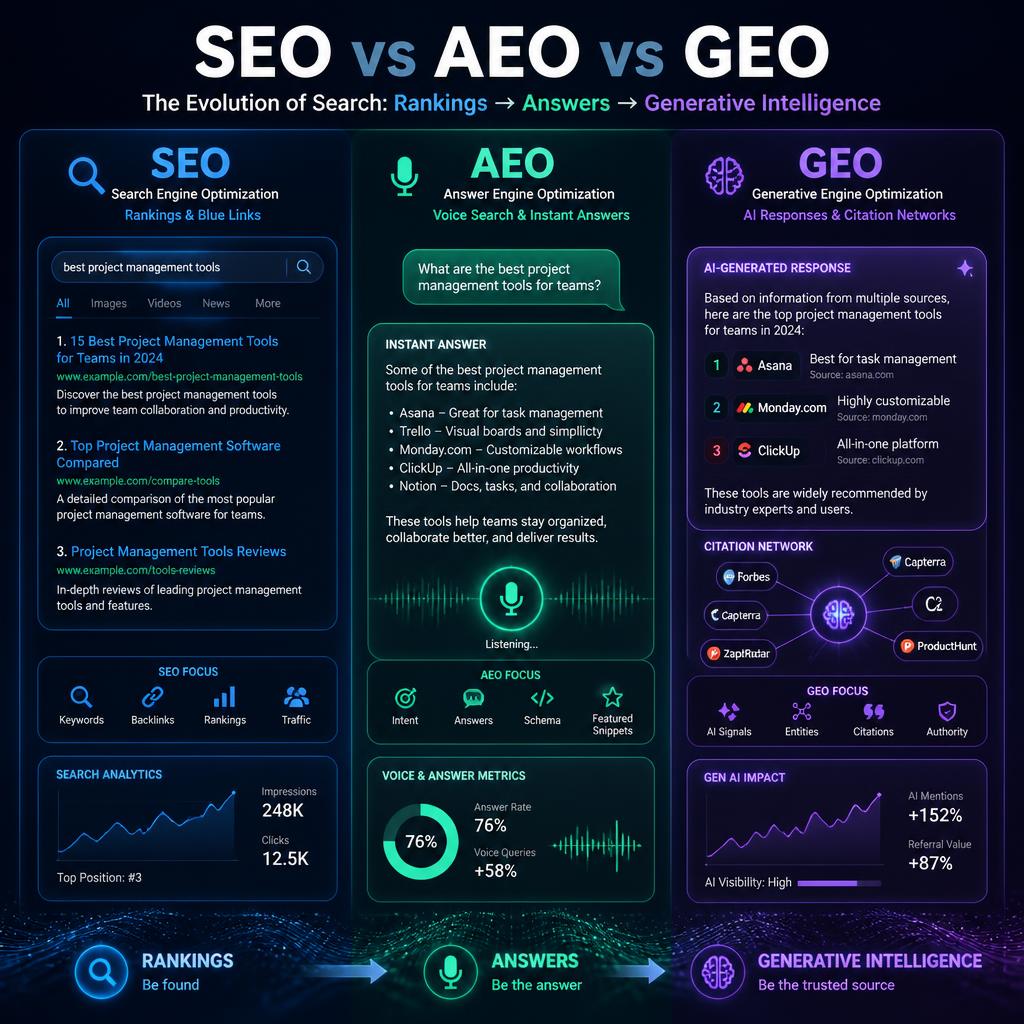
SEO (Search Engine Optimization) focuses on improving visibility in traditional search engines. AEO (Answer Engine Optimization) focuses on providing direct answers that can be selected and displayed by answer engines. GEO (Generative Engine Optimization) focuses on increasing the likelihood that content will be referenced, cited, or represented accurately in generative AI responses.
Although these strategies overlap, they are not identical. Understanding the differences between AEO vs GEO vs SEO can help businesses create content that remains visible across traditional search, AI-generated answers, and emerging search experiences.
AEO vs GEO vs SEO: Quick Answer
SEO, AEO, and GEO are complementary optimization strategies with different primary goals. SEO focuses on improving visibility in traditional search results, AEO focuses on providing clear answers that can be surfaced directly by answer engines, while GEO focuses on increasing the visibility, citation, and accurate representation of content in generative AI search experiences. In practice, businesses can combine all three by creating technically strong, authoritative content that answers questions directly and provides comprehensive, trustworthy information.
In simple terms:
- SEO: Get found in traditional search results.
- AEO: Get selected as a direct answer.
- GEO: Get referenced or represented in AI-generated responses.
The best approach is usually not to choose only one. A single well-structured piece of content can target SEO rankings, AEO answer visibility, and GEO/AI visibility at the same time.
What Is SEO?
SEO is the process of optimizing a website and its content to improve visibility in traditional organic search results.
Search engine optimization covers technical, content, authority, and user-experience factors that can affect how pages are discovered, interpreted, and ranked.
Important SEO activities include:
- Keyword research
- Search intent optimization
- On-page optimization
- Technical SEO
- Internal linking
- Content development
- Link building
- Mobile optimization
- Website performance
- Structured data
- Improving user experience
For example, a company targeting the keyword “best laptop deals online” may create a comprehensive guide optimized around that search intent. The goal is to make the page useful and discoverable when users search through traditional search engines.
What Does SEO Focus On?
SEO generally focuses on questions such as:
- Can search engines crawl the page?
- Does the content satisfy search intent?
- Is the information useful and relevant?
- Does the website demonstrate authority?
- Is the page technically accessible?
- Does the content deserve visibility for the target query?
SEO therefore remains an important foundation for digital visibility.
AI Overviews Traffic Impact: 2026 Guide
GEO vs SEO: What You Need to Know in 2026
What Is AEO?
AEO, or Answer Engine Optimization, is the practice of structuring content so that it can provide clear, direct answers to user questions.
Instead of focusing exclusively on ranking a webpage, AEO emphasizes the answer itself.
AEO became increasingly important as search experiences began providing direct answers instead of requiring users to visit multiple webpages.
Common AEO targets include:
- Definition questions
- How-to questions
- Comparison questions
- Frequently asked questions
- Product specifications
- Short factual queries
- Conversational searches
For example, instead of creating a page that only targets “AEO”, an AEO-focused article may directly answer:
What is AEO?
A concise answer immediately following the question gives search and AI systems a clearly structured piece of information that can potentially be used when generating an answer.
What Does AEO Focus On?
AEO emphasizes:
- Direct answers
- Clear question-and-answer structures
- Concise explanations
- Search intent
- Natural-language queries
- FAQ content
- Structured information
- Featured-answer opportunities
The goal is not simply to rank a page. The goal is to make the information easy for an answer engine to understand and use.
What Is GEO?
GEO, or Generative Engine Optimization, focuses on improving the visibility and representation of content within generative AI search experiences.
Generative systems can synthesize information from multiple sources and produce an answer rather than displaying only a traditional list of search results.
GEO therefore emphasizes factors such as:
- Clear and authoritative information
- Original research
- Reliable data
- Expert sources
- Strong topical coverage
- Citability
- Brand authority
- Well-structured content
- Factual consistency
GEO can be relevant to generative search experiences and AI systems that synthesize information from multiple sources.
For example, an organization publishing original research with transparent methodology, statistics, expert commentary, and clearly attributed sources may create content that is more useful to systems attempting to generate evidence-based responses.
How Search Is Changing in 2026
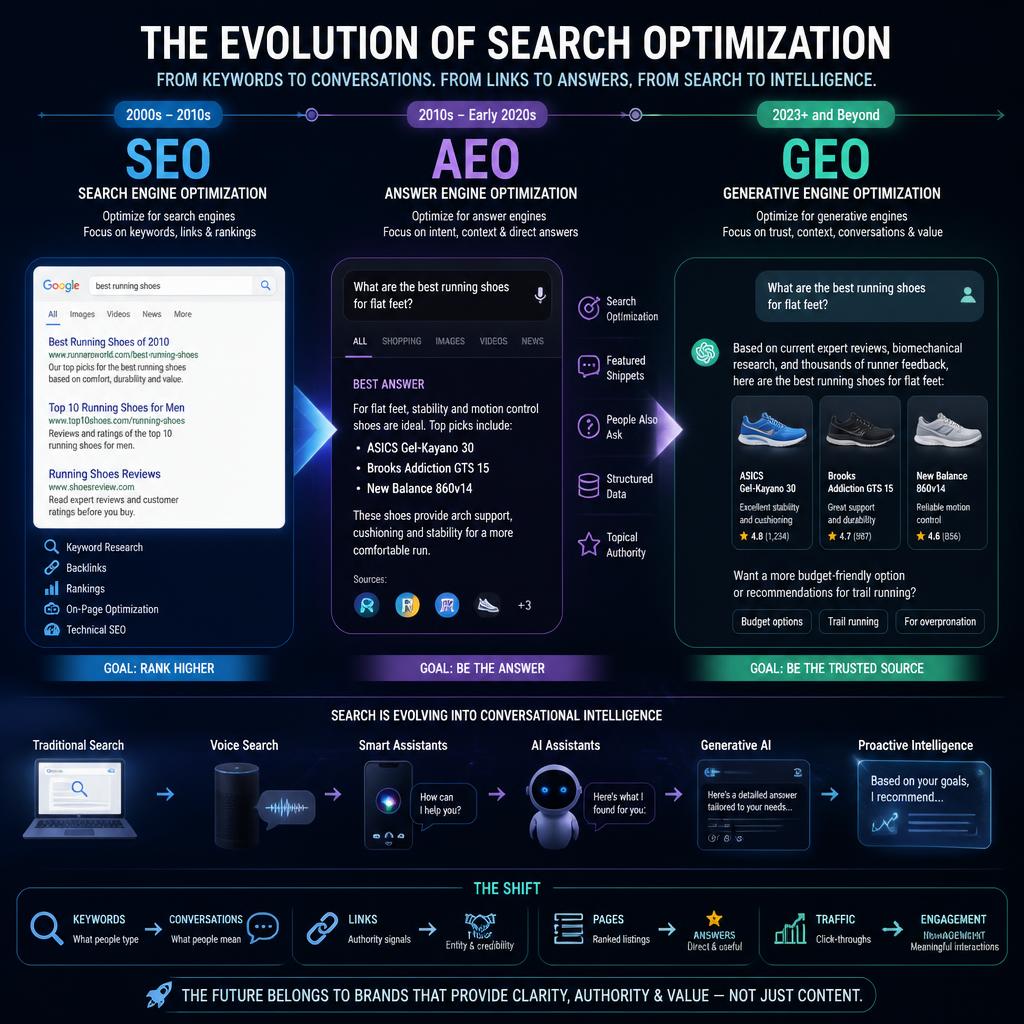
Search behavior is becoming more conversational and increasingly influenced by AI-powered experiences. Users can now move between traditional search results, direct answers, AI-generated summaries, and conversational interfaces depending on the type of information they need.
This creates several important search experiences:
- Traditional search: Users browse organic results and choose which pages to visit.
- AI-generated answers: Systems summarize information from multiple sources.
- Conversational search: Users ask follow-up questions instead of creating a new search query each time.
- Zero-click searches: Users may receive enough information directly in the search interface without visiting a website.
- Multi-step research: Users can use AI systems to compare information, evaluate options, and continue refining their questions.
This does not mean traditional SEO has disappeared. Instead, the search environment is becoming more diverse.
For businesses, this means content needs to work at multiple levels: it should be discoverable, easy to understand, directly answer important questions, and provide enough authority and evidence to be useful in more advanced search experiences.
That is why SEO, AEO, and GEO are increasingly complementary rather than isolated strategies.
AEO vs GEO vs SEO: Key Differences
The simplest way to understand the three strategies is to look at what each one is primarily trying to accomplish.
| Strategy | Primary Focus | Typical Objective |
|---|---|---|
| SEO | Traditional search visibility | Improve organic search visibility |
| AEO | Direct answers | Make information easy to extract as an answer |
| GEO | Generative AI visibility | Increase the likelihood of being referenced or represented in AI-generated responses |
The strategies overlap considerably, but their optimization priorities are different.
SEO vs AEO vs GEO: Target Platforms
SEO traditionally targets search engines and their organic results.
AEO is particularly relevant to search experiences that provide direct answers, snippets, summaries, and conversational responses.
GEO is relevant to generative AI and AI-powered search experiences.
| Strategy | Examples of Relevant Search Experiences |
|---|---|
| SEO | Google, Bing and other traditional search engines |
| AEO | Featured snippets, direct-answer experiences, conversational search |
| GEO | Generative AI search and AI-powered answer systems |
The boundaries are not absolute. Modern search platforms increasingly combine traditional rankings, AI-generated summaries, direct answers, and citations.
SEO vs AEO vs GEO: Content Strategy
The content format also differs.
SEO Content
SEO content often benefits from comprehensive topical coverage. Depending on the search intent, this can include:
- Detailed guides
- Product comparisons
- Category pages
- Service pages
- Tutorials
- Reviews
- Supporting resources
The objective is to satisfy the user’s search intent while demonstrating relevance and authority.
AEO Content
AEO content should make answers easy to identify.
A useful structure is:
Question → Direct Answer → Explanation → Supporting Evidence
For example:
What is GEO?
GEO is the practice of optimizing content for visibility and accurate representation in generative AI search experiences.
The following paragraphs can then explain how GEO works, why it matters, and how businesses can implement it.
GEO Content
GEO content should provide information that generative systems can confidently understand and reference.
Useful characteristics include:
- Original statistics
- Primary research
- Expert commentary
- Clear definitions
- Specific examples
- Updated information
- Transparent methodology
- Authoritative references
This does not mean writing exclusively for AI systems. Content still needs to be useful to human readers.
AI Search Optimization Checklist 2026
How Long Should SEO, AEO, and GEO Content Be?
There is no universal word count that guarantees visibility in any of these systems.
Instead of following rigid length rules, match the content depth to the search intent.
A useful framework is:
| Strategy | Useful Content Structure |
|---|---|
| SEO | Comprehensive content appropriate to the topic |
| AEO | Concise answer followed by supporting detail |
| GEO | Clear, authoritative information supported by evidence |
For an article targeting all three, a strong approach is to provide the direct answer first and then expand into detailed explanations.
This creates content that works for users who want a quick answer as well as users who want comprehensive information.
How AEO and GEO Work Together
AEO and GEO are closely related, but they are not exactly the same.
AEO asks:
“How can I make the answer easy to identify and use?”
GEO asks:
“How can I make my information useful, credible, and visible within generative AI experiences?”
A page can therefore use AEO principles to structure its information while using GEO principles to strengthen its authority and citability.
For example, a research article could begin with a 50-word answer, followed by methodology, statistics, expert commentary, and supporting evidence.
That structure serves both direct-answer and generative-search use cases.
How SEO, AEO, and GEO Work Together
Businesses do not necessarily need three completely separate content strategies.
A single well-structured page can incorporate all three.
A practical structure looks like this:
1. Clear Introduction
Explain the topic and immediately address the primary question.
2. Direct Answer
Provide a concise answer suitable for users looking for a quick explanation.
3. Detailed Explanation
Expand the subject with examples, definitions, statistics, and context.
4. Supporting Questions
Add relevant questions users may ask about the topic.
5. Original Information
Include research, examples, data, expert insights, or first-hand experience where appropriate.
6. Technical Optimization
Make sure the page is crawlable, accessible, fast, mobile-friendly, and properly structured.
7. Internal and External References
Connect the page to related resources and cite credible sources where appropriate.
This integrated structure allows one content asset to support traditional search and AI-driven discovery without creating unnecessary duplicate content.
How to Optimize One Article for SEO, AEO, and GEO
You do not need to create three separate articles to target SEO, AEO, and GEO. A single comprehensive resource can be structured to support all three approaches.
A practical content structure looks like this:
1. Start With the Main Search Intent
Identify the primary question or problem the user wants to solve. Use this intent to determine the article’s main topic, title, and structure.
2. Provide an Answer-First Summary
Give a concise answer near the beginning of the article. This helps readers understand the topic immediately and creates a clearly defined answer section.
3. Build Comprehensive Sections
Expand the subject using logical H2 and H3 headings. Cover related questions, examples, comparisons, and important subtopics rather than repeating the primary keyword.
4. Add Question-Based Sections
Include natural questions users may ask about the subject. Answer each question directly before providing additional context.
5. Include Original Information
Where possible, add original research, statistics, examples, case studies, expert commentary, or first-hand observations. Original information can make a resource more useful and distinctive.
6. Strengthen Trust and Authority
Clearly identify authors, sources, publication dates, research methods, and supporting evidence where appropriate.
7. Optimize the Technical Foundation
Make the page easy to crawl, understand, and access. Review internal links, mobile usability, page performance, structured data, indexing, and accessibility.
8. Keep the Content Updated
Review important pages periodically and update information when statistics, platforms, products, or industry practices change.
The result is a single content asset that combines SEO-friendly structure, AEO-friendly answers, and GEO-oriented authority and evidence.
Real-World Example: SEO vs AEO vs GEO
Consider an ecommerce website targeting the topic “best laptop deals.”
The same topic can be optimized differently depending on the search experience.
SEO Approach
The website could create a comprehensive page covering laptop categories, prices, specifications, buying considerations, and current deals.
The page could target relevant search terms such as:
- Best laptop deals
- Best laptop deals online
- Cheap laptop deals
- Laptop discounts
- Best laptops for the money
The goal is to create a useful resource that can compete for relevant organic searches.
AEO Approach
The page could begin with a direct answer to a common question:
What are the best laptop deals?
A concise answer could summarize what shoppers should look for, followed by a comparison of available options.
Additional questions could include:
- What is a good laptop deal?
- How much should I spend on a laptop?
- Which laptop is best for students?
- What specifications should I look for?
This makes the information easier to understand and use for answer-oriented searches.
GEO Approach
The same page could provide additional evidence and original value, such as:
- Original price comparisons
- Historical pricing data
- Product specifications
- Expert analysis
- Clearly identified sources
- Updated information
- First-hand testing or observations
This gives generative systems more useful and verifiable information to work with.
The Combined Approach
The strongest version of the page does not choose only one strategy.
It combines:
SEO → comprehensive search-focused content
AEO → direct answers to important questions
GEO → authoritative, evidence-based, and distinctive information
This example illustrates why modern content optimization is increasingly about creating one genuinely useful resource that can serve multiple search experiences.
How to Optimize Content for SEO in 2026
A modern SEO strategy should start with search intent rather than simply inserting keywords.
1. Identify Search Intent
Determine whether the user wants:
- Information
- A comparison
- A product
- A service
- A solution
- A tutorial
2. Build Comprehensive Topic Coverage
Cover the important aspects of the subject instead of repeating the same keyword.
Use related concepts and semantic keywords naturally.
3. Improve Technical SEO
Important areas include:
- Crawlability
- Indexability
- Site architecture
- Mobile usability
- Page performance
- Internal linking
- Structured data
4. Build Authority
Create valuable resources that naturally earn references and links.
Original research, useful statistics, and genuinely helpful content can strengthen a website’s overall authority.
How to Optimize Content for AEO
AEO optimization is largely about making answers easy to identify.
Use Question-Based Headings
Examples include:
- What is AEO?
- How does AEO work?
- Why is AEO important?
- What is the difference between AEO and SEO?
- How can businesses optimize for answer engines?
Answer Questions Immediately
Do not hide the answer beneath several paragraphs of introduction.
Give users the core answer first and then provide additional context.
Use Structured Formatting
Helpful formats include:
- Short paragraphs
- Bullet points
- Numbered steps
- Comparison tables
- FAQs
- Definitions
Clear formatting makes information easier for both users and automated systems to process.
How to Optimize Content for GEO
GEO requires more than simply mentioning artificial intelligence.
The content should provide information that is useful as a source.
Publish Original Data
Original research can differentiate your content from pages that simply repeat existing information.
Examples include:
- Surveys
- Industry statistics
- Original experiments
- Market analysis
- Case studies
Demonstrate Expertise
Clearly identify:
- Authors
- Qualifications
- Research methodology
- Sources
- Publication dates
- Updates
Make Claims Verifiable
Avoid vague statements when specific evidence is available.
Instead of saying:
“AI search is changing everything.”
Provide measurable information and explain where it came from.
Keep Information Updated
AI systems and search platforms evolve quickly. Outdated statistics and obsolete platform information can reduce the usefulness of an article.
Regularly review important pages and update information when the underlying facts change.
Keyword Strategy for SEO, AEO, and GEO
Keyword research remains useful, but modern optimization should go beyond exact-match keywords.
A topic can be organized around:
Primary keyword:
AEO vs GEO vs SEO
Related keywords:
- AEO vs SEO
- GEO vs SEO
- GEO vs AEO
- Generative Engine Optimization
- Answer Engine Optimization
- AI search optimization
- AI SEO
- search engine optimization
- generative search
- answer engine optimization strategy
- AI visibility
- AI search visibility
- optimization for ChatGPT
- optimization for generative search
- zero-click search
The goal is to use these terms naturally where they genuinely help explain the subject.
Measuring SEO, AEO, and GEO Performance
Different optimization strategies require different measurement approaches.
SEO Metrics
Track:
- Organic impressions
- Organic clicks
- Search rankings
- Organic traffic
- Conversion rate
- Revenue from organic search
- Click-through rate
AEO Metrics
Potential indicators include:
- Appearance in direct-answer experiences
- Featured snippet visibility
- Search-result enhancements
- Question coverage
- Click-through rates from answer surfaces
Measurement can be more difficult than traditional SEO because answer engines do not always expose complete visibility data.
GEO Metrics
Possible indicators include:
- AI citations
- Brand mentions
- Referral traffic from AI platforms
- Frequency of source inclusion
- Context in which the brand is mentioned
- Visibility across generative search experiences
GEO measurement is still developing, so businesses should avoid treating any single third-party AI visibility metric as a complete representation of performance.
A Practical AEO, GEO, and SEO Content Framework
For businesses creating a new article, the following workflow can combine the three approaches.
Step 1: Research the Topic
Identify the primary search intent, related questions, competing content, and important entities associated with the topic.
Step 2: Write the Direct Answer
Create a concise answer near the beginning of the article.
Step 3: Expand the Topic
Add detailed explanations, examples, statistics, and relevant subtopics.
Step 4: Add Supporting Questions
Use natural questions that reflect what users are likely to ask.
Step 5: Add Original Value
Include original research, examples, data, analysis, or first-hand experience whenever possible.
Step 6: Optimize the Page Technically
Review indexing, internal links, structured data, mobile usability, performance, and accessibility.
Step 7: Update and Measure
Monitor search visibility, traffic, conversions, answer appearances, citations, and brand mentions where measurable.
Common Mistakes to Avoid
Mistake 1: Treating GEO as AI Keyword Stuffing
Adding phrases such as “ChatGPT,” “AI search,” and “generative AI” repeatedly does not automatically make content optimized for generative engines.
Focus on information quality and usefulness instead.
Mistake 2: Writing Extremely Short Answers
AEO values direct answers, but a page still needs enough context to fully satisfy the user’s intent.
Use a concise answer as the entry point and provide deeper information afterward.
Mistake 3: Ignoring Traditional SEO
AI search does not eliminate the importance of technical accessibility, content quality, authority, and search visibility.
Mistake 4: Creating Separate Articles for Every Similar Question
Publishing dozens of thin pages that answer nearly identical questions can create unnecessary duplication.
Instead, consider building comprehensive topic hubs with clearly organized answers.
Mistake 5: Making Unsupported Claims
AI-generated content can spread inaccurate information quickly.
Use reliable sources, verify important claims, and distinguish original analysis from established facts.
AEO vs GEO vs SEO Comparison Table
| Factor | SEO | AEO | GEO |
|---|---|---|---|
| Primary objective | Organic search visibility | Direct-answer visibility | Generative AI visibility |
| Main focus | Search rankings | Answers | AI-generated responses |
| Content style | Comprehensive | Direct and concise | Authoritative and evidence-based |
| Keyword strategy | Keywords + search intent | Questions + conversational queries | Topics + entities + natural language |
| Important signals | Relevance, technical quality, links, authority | Clarity, structure, answer quality | Authority, originality, evidence, citability |
| Typical content | Guides, pages, resources | FAQs, definitions, direct answers | Research, data, authoritative resources |
| Main measurement | Rankings, traffic, conversions | Answer appearances, visibility | Citations, mentions, AI referral traffic |
| Best use | Traditional search discovery | Quick answers | Generative search discovery |
Should You Focus on SEO, AEO, or GEO?
For most organizations, the practical question is not which strategy replaces the others.
Instead, consider where your audience searches and structure your content accordingly.
If users primarily discover your business through traditional search, technical SEO, search intent, content quality, and authority remain important.
If your audience frequently asks direct questions, AEO principles can help make your content easier to understand and extract.
If your industry increasingly appears in AI-generated search experiences, GEO principles can help you create authoritative, evidence-based content that can potentially be referenced by generative systems.
The same article can often support all three.
2026 Content Optimization Roadmap
Months 1–2: Foundation
- Audit existing content
- Identify important search topics
- Map search intent
- Identify frequently asked questions
- Review technical SEO
- Establish measurement systems
Months 3–4: Content Implementation
- Add direct-answer sections
- Create comprehensive topic guides
- Build FAQ sections where appropriate
- Publish original research
- Strengthen internal linking
- Improve author and source information
Months 5–6: Optimization
- Analyze organic performance
- Monitor AI visibility where measurable
- Identify content gaps
- Update outdated information
- Expand successful topics
- Test different content structures
Frequently Asked Questions
Is GEO the same as SEO?
No. SEO focuses primarily on improving visibility in traditional search environments, while GEO focuses on visibility and representation within generative AI search experiences. The two overlap because high-quality, authoritative content can support both.
Is AEO replacing SEO?
No. AEO addresses the growing importance of direct answers, while SEO continues to support traditional organic search visibility. Modern content can use principles from both.
What is the difference between AEO and GEO?
AEO emphasizes making information easy to provide as a direct answer. GEO focuses more broadly on how content can be discovered, referenced, and represented in generative AI responses.
Does SEO still matter in 2026?
Yes. Traditional search remains an important discovery channel, and technical accessibility, relevant content, authority, and user experience continue to matter for organic visibility.
How do I optimize a website for AI search?
Start with accurate, authoritative, well-structured content. Provide direct answers to important questions, publish original information, cite reliable sources, maintain strong technical SEO, and keep important content updated.
How long should an AEO answer be?
There is no universal ideal length. The answer should be concise enough to directly satisfy the question while providing enough context to avoid being misleading or incomplete.
Can one article rank for SEO and appear in AI answers?
Yes. A single high-quality article can be structured to serve traditional search users and AI-powered answer experiences. Clear answers, comprehensive coverage, authoritative information, and strong technical foundations can support multiple discovery channels.
Final Takeaway: AEO vs GEO vs SEO
SEO, AEO, and GEO represent different but overlapping approaches to modern search visibility.
SEO focuses on traditional organic search. AEO focuses on direct answers and answer-oriented search experiences. GEO focuses on visibility and representation within generative AI systems.
The strongest content strategy does not require completely separate content for every search technology. Instead, businesses can create useful, authoritative content that:
- Satisfies search intent
- Provides direct answers
- Covers topics comprehensively
- Uses natural language
- Includes reliable evidence
- Demonstrates expertise
- Provides original information
- Maintains strong technical SEO
- Is regularly reviewed and updated
As search continues to evolve, the fundamental principle remains consistent: create information that is genuinely useful, accurate, accessible, and easy to understand.
By combining SEO fundamentals with AEO-friendly answer structures and GEO-oriented authority signals, businesses can build content designed for a search environment that increasingly includes both traditional results and AI-generated experiences.