How to Get Cited by ChatGPT in 2026: Complete Strategy
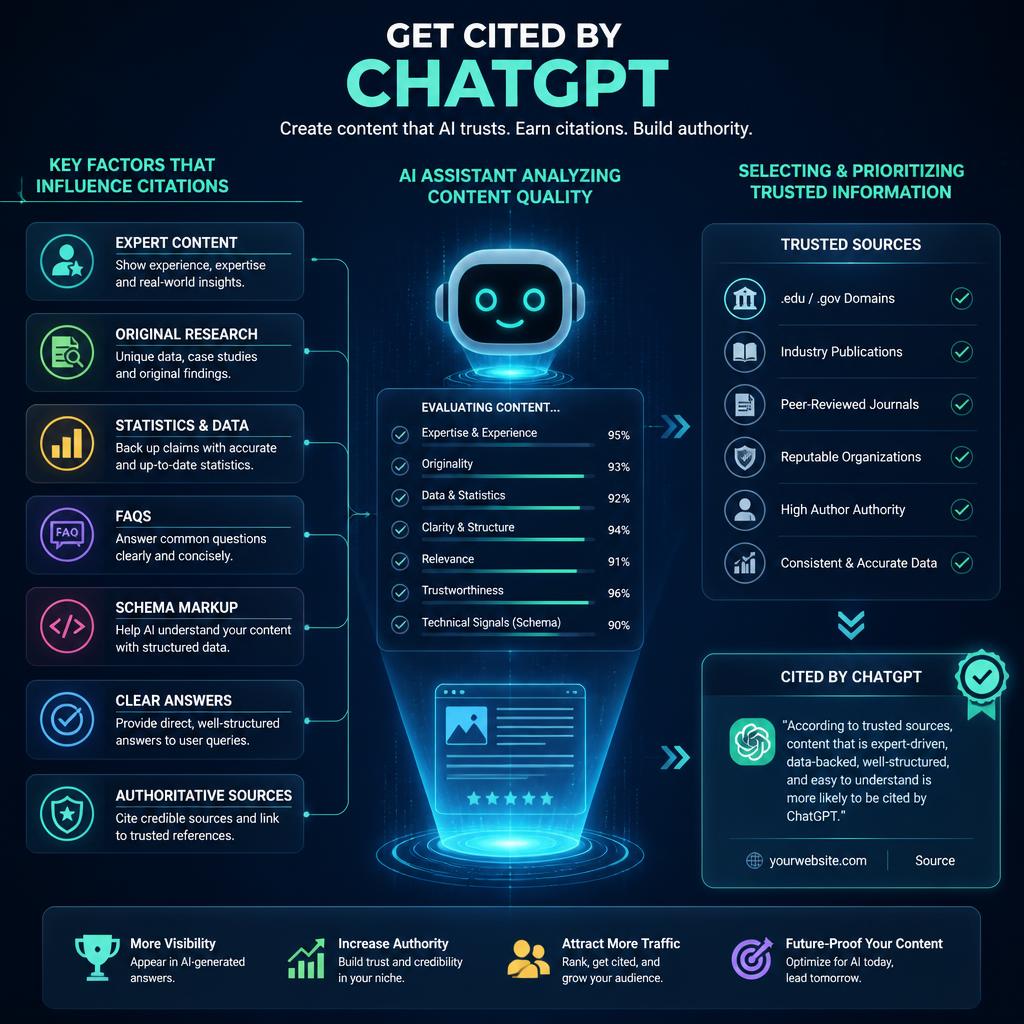
Getting cited by ChatGPT can increase your brand’s visibility when people use AI search to research products, services, companies, and topics. But there is no guaranteed formula for earning a citation.
The practical approach is to make your website easy for search systems to discover, understand, verify, and reference. That means combining strong SEO fundamentals with useful, original, well-structured content and a technically accessible website.
This guide explains how to increase your chances of being cited by ChatGPT in 2026 while also improving visibility across Google AI Overviews, AI Mode, and other AI-powered search experiences.
What Does It Mean to Be Cited by ChatGPT?
A ChatGPT citation occurs when ChatGPT uses information from a webpage and provides that webpage as a source or reference in its response.
ChatGPT Search can retrieve information from the web and provide links to relevant sources. OpenAI explains that public websites can appear in ChatGPT Search, and publishers can improve discoverability by allowing the OAI-SearchBot to access their content.
For publishers, this creates another discovery channel beyond traditional search engines.
However, being indexed does not guarantee that ChatGPT will cite your page. Search systems still have to determine whether a page is relevant and useful for a particular query.
Why ChatGPT Citations Matter for SEO in 2026
AI search is changing how people discover information online.
Instead of clicking through several traditional search results, a user may ask an AI system a complete question and receive a synthesized answer with links to supporting sources.
A citation can therefore provide several potential benefits:
- Increased brand visibility
- Referral traffic from AI search
- Additional exposure for informational content
- Greater awareness of your expertise
- Opportunities to reach users earlier in the buying journey
- More visibility for original research and data
- Additional distribution for high-quality evergreen content
ChatGPT itself describes its search experience as a way to connect users with timely information and relevant web sources.
However, it is important not to treat ChatGPT citations as a guaranteed traffic source. Citation frequency can vary by query, topic, source availability, freshness, and the way a search system retrieves information.
How Does ChatGPT Choose Sources?
There is no publicly documented checklist saying that a page receives a citation because it has a specific word count, a particular heading structure, or exactly 50–150 words in an answer box.
Instead, focus on the factors you can control.
1. Relevance to the Question
The page should directly address the topic being searched.
For example, an article targeting “how to measure AI search traffic” should provide practical information about AI referral traffic, attribution, analytics, tracking methods, limitations, and examples.
Avoid creating a page that mentions the keyword repeatedly without actually answering the underlying question.
2. Accuracy and Reliability
AI systems need useful information that can be supported and verified.
Make factual claims carefully and provide sources when appropriate. If statistics can change over time, include the publication or update date and identify the source.
Google’s guidance similarly emphasizes accurate, reliable, people-first content rather than content created primarily to manipulate search rankings.
Measuring AI Search Traffic in 2026: Complete Guide
3. Original Information
Original information gives your page something distinctive to offer.
Examples include:
- Original surveys
- First-party data
- Case studies
- Experiments
- Industry analysis
- Proprietary benchmarks
- Original interviews
- Real-world testing
- Unique comparisons
A page that simply rewrites five existing articles has less opportunity to become the original source that others reference.
4. Clear Context
A strong article should make it obvious:
- Who created it
- What the topic is
- When the information was published or updated
- What sources support important claims
- Whether the information is based on research, testing, or expert analysis
These signals also help human readers evaluate the information.
How to Get Your Website Cited by ChatGPT
There is no guaranteed “ChatGPT citation hack.” Instead, use the following process.
Step 1: Identify Questions People Ask AI
Start with questions rather than keywords alone.
Traditional keyword research might identify:
AI search traffic
But users may ask an AI system:
- How do I measure AI search traffic?
- How can I track ChatGPT referrals?
- What is AI search traffic?
- Which analytics tools track AI referrals?
- How can I tell whether ChatGPT sends visitors to my website?
Build content that answers the complete information need behind the keyword.
This approach can improve traditional SEO while making the page more useful for conversational search.
Step 2: Put the Direct Answer Near the Beginning
Answer the primary question quickly.
A useful structure is:
Question: What is AI search traffic?
Direct answer: AI search traffic is website traffic generated when users discover and visit a website through AI-powered search or conversational systems such as ChatGPT and other generative search experiences.
Then expand on the definition with examples, tracking methods, limitations, and practical recommendations.
This is useful for readers and makes the main subject of the page immediately clear.
However, don’t force every answer into an arbitrary 40-, 50-, or 150-word format. Google explicitly states that there is no ideal page length or requirement to break content into tiny pieces for generative AI systems.
Step 3: Build a Clear Content Structure
Organize your article around the questions users actually need answered.
A strong structure could look like:
- What is the topic?
- Why does it matter?
- How does it work?
- How do you implement it?
- What tools can you use?
- What mistakes should you avoid?
- How do you measure results?
- Frequently asked questions
Use descriptive H2 and H3 headings, short paragraphs, lists, tables, examples, and relevant internal links.
The goal isn’t to create a page specifically for machines. The goal is to make the information easy for both humans and search systems to understand.
Step 4: Add Original Research and Evidence
Original research can make your content more valuable and more reference-worthy.
For example, instead of writing another generic article about AI search, publish:
“AI Referral Traffic Study: 10,000 Sessions Analyzed Across 50 Websites”
You could analyze:
- Referral sources
- Landing pages
- Conversion rates
- User behavior
- Traffic growth
- Differences between AI platforms
- Changes over time
Then explain your methodology and limitations.
Original research can also generate secondary mentions when other publishers reference your findings.
Step 5: Strengthen Author and Website Trust Signals
Make it easy for readers to understand who is behind your content.
Consider providing:
- Author name
- Author biography
- Relevant experience
- Author page
- Editorial policy
- About page
- Contact information
- Sources and references
- Publication dates
- Update dates
Google’s people-first content guidance specifically encourages publishers to demonstrate expertise and provide information that helps readers understand the expertise behind a page.
Don’t manufacture credentials. Only claim experience, qualifications, or expertise that can be accurately supported.
Step 6: Make Sure ChatGPT Can Access Your Content
Technical accessibility is one of the most important practical considerations.
OpenAI’s publisher guidance specifically says that websites should avoid blocking OAI-SearchBot if they want their content to be discovered, surfaced, and clearly cited in ChatGPT Search.
Check your:
- robots.txt
- CDN rules
- Firewall
- Bot protection
- Server responses
- Page accessibility
- noindex directives
For example, a website can have excellent content but still have discovery problems if important pages are blocked from relevant crawlers.
Also remember that allowing a crawler does not guarantee citation.
Step 7: Keep Important Information in Text
Don’t hide essential information inside images, videos, or interfaces that require JavaScript to reveal the content.
Important facts should be available as crawlable page text.
This includes:
- Definitions
- Product specifications
- Prices when relevant
- Research findings
- Key statistics
- Explanations
- Methodology
- Important conclusions
Google’s guidance for AI search similarly recommends ensuring important content is available in textual form.
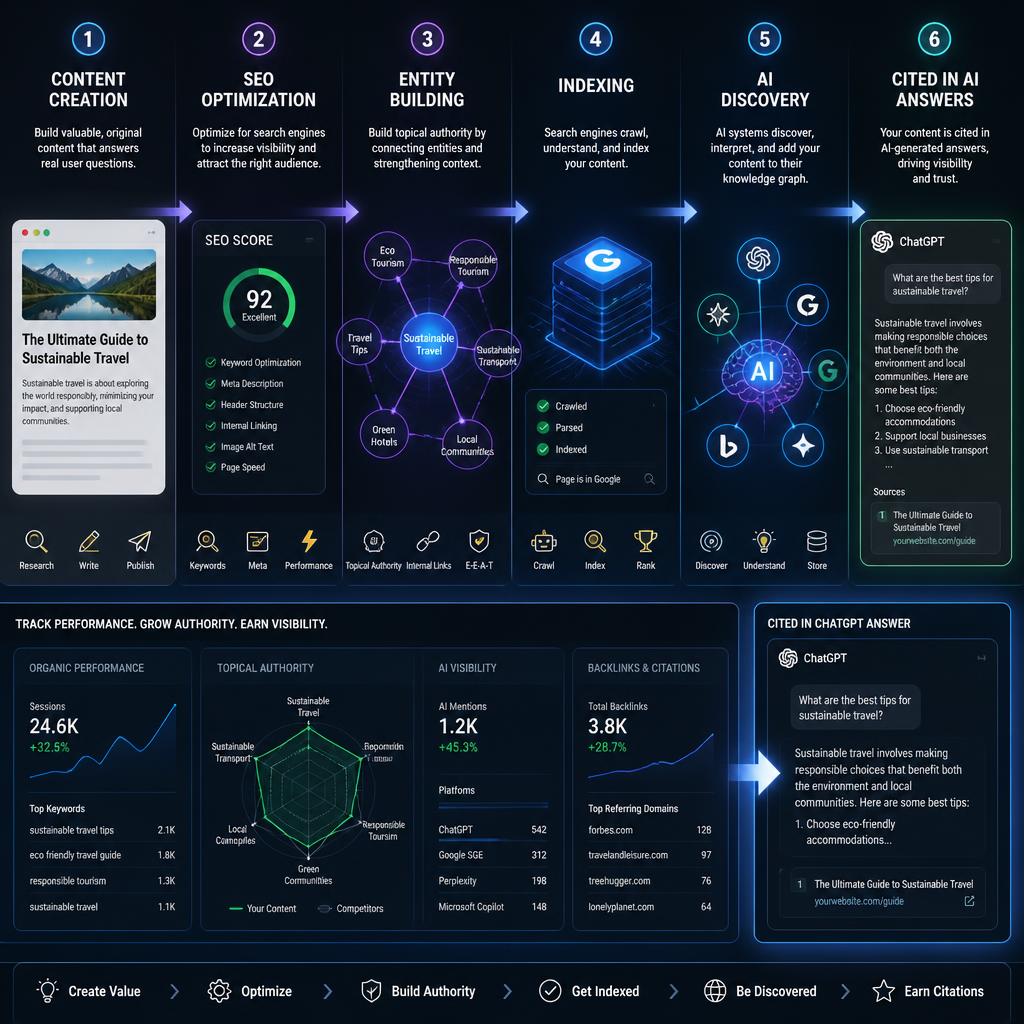
Step 8: Use Structured Data Correctly
Structured data can help search engines understand what a page represents.
Depending on the page, appropriate markup may include:
- Article
- Organization
- Person
- Product
- Breadcrumb
- FAQ where applicable
But don’t assume schema automatically makes ChatGPT cite your page.
Google explicitly says there is no special schema.org markup required for AI Overviews or AI Mode. Structured data remains useful as part of normal SEO, but it should accurately represent the visible page content.
In other words:
Use structured data for better machine understanding and eligible search features—not as a guaranteed AI citation technique.
Step 9: Build Strong Internal Links
Internal links help search engines discover related content and understand the relationships between pages.
For example, an AI search content hub could contain:
- What Is Generative Engine Optimization?
- AEO vs. GEO vs. SEO
- How to Measure AI Search Traffic
- How to Get Cited by ChatGPT
- AI Search Analytics Tools
- How AI Search Changes SEO
Connect these articles using descriptive anchor text.
This creates a topical content network instead of isolated articles.
Step 10: Earn Relevant External Mentions
External links and mentions can help establish that your content is useful beyond your own website.
Focus on earning mentions naturally through:
- Original research
- Digital PR
- Expert commentary
- Industry studies
- Useful tools
- Data reports
- Unique resources
- Expert contributions
Avoid mass-producing low-quality mentions simply to manipulate AI visibility.
Google’s current guidance specifically warns against pursuing inauthentic mentions and emphasizes high-quality content and genuine value.
Content Types That Can Perform Well in AI Search
Different types of content can satisfy different search intents.
Original Research
Research is particularly useful when other publishers need supporting evidence.
Examples:
- Industry surveys
- Market reports
- Statistics
- Benchmark studies
- First-party datasets
Detailed Guides
Comprehensive guides can answer multiple related questions on one topic.
Examples:
- How-to guides
- Tutorials
- Implementation guides
- Technical documentation
Definitions
Clear definitions can answer straightforward informational queries.
For example:
What is Generative Engine Optimization?
Follow the definition with examples, use cases, limitations, and related concepts.
Comparisons
Comparison pages can address users evaluating alternatives.
Examples:
- SEO vs. GEO
- AEO vs. GEO
- ChatGPT vs. Google AI search
- Analytics tools comparison
The information should be evidence-based rather than artificially designed to promote one option.
Case Studies
Case studies provide real-world context.
A strong case study should explain:
- Starting situation
- Methodology
- Actions taken
- Results
- Time period
- Data
- Limitations
- Lessons learned
ChatGPT Citation SEO: Keywords to Target
Instead of repeatedly using one keyword, create a semantic keyword cluster.
Primary keywords
- how to get cited by ChatGPT
- ChatGPT citations
- get cited by ChatGPT
- ChatGPT search citations
- ChatGPT SEO
Related keywords
- AI search optimization
- AI search SEO
- generative engine optimization
- GEO
- answer engine optimization
- AEO
- AI visibility
- ChatGPT search
- AI search traffic
- AI search optimization strategy
- generative AI search
- AI citations
- LLM visibility
- AI referral traffic
Question-based keywords
- How does ChatGPT choose sources?
- How can I get my website cited by ChatGPT?
- Does ChatGPT cite websites?
- How does ChatGPT Search work?
- How do I optimize content for AI search?
- How do I track ChatGPT traffic?
- Does schema help with AI search?
Use these naturally where they genuinely match the content.
How does AI help with online shopping? – 2026
How to use AI to create an eCommerce website? –
Which AI is best for marketing strategy? –
How to Measure ChatGPT Citations
Citation measurement is more complicated than traditional Google ranking tracking.
Start with several methods.
1. Manual Query Testing
Create a list of important queries related to your business.
Search them periodically in ChatGPT Search and record:
- Whether your website appears
- Which page is cited
- The context of the citation
- Competing sources
- Changes over time
Don’t treat one search as definitive because AI search results can vary.
2. Analyze Referral Traffic
Check your analytics platform for traffic associated with ChatGPT and other AI referral sources.
Track:
- Sessions
- Users
- Landing pages
- Engagement
- Conversions
- Revenue where applicable
Referral data will not necessarily capture every AI-assisted discovery, so it should be treated as one measurement method rather than a complete representation of AI visibility.
3. Track Landing Pages
Identify which pages receive visits from AI platforms.
You may discover that your highest-performing AI referral pages are not your traditional highest-ranking pages.
This can reveal new content opportunities.
4. Track Brand Mentions
Monitor whether AI systems mention your:
- Brand
- Products
- Services
- Research
- Authors
- Publications
This is especially useful for measuring broader AI visibility.
Common Mistakes That Can Reduce AI Search Visibility
Writing Only for Keywords
Keyword targeting is useful, but an article should answer a real user need.
Rewriting Existing Articles Without Adding Value
Google recommends original, helpful content rather than simply reproducing what already exists.
Making Unsupported Claims
Don’t write statements such as “ChatGPT always prioritizes pages with 150-word answer capsules” unless you have reliable evidence.
There is a major difference between a practical recommendation and a documented ranking factor.
Blocking AI Crawlers
If you want ChatGPT Search to discover your content, review whether your technical configuration blocks OAI-SearchBot.
Overusing Structured Data
Schema can help search engines understand your content, but it isn’t a shortcut to AI citations.
Ignoring Traditional SEO
AI search doesn’t eliminate SEO.
Google states that its generative AI search experiences continue to rely on core Search systems and fundamental SEO practices.
ChatGPT SEO vs. Traditional SEO
The two strategies overlap significantly.
| Traditional SEO | AI Search Optimization |
|---|---|
| Keyword research | Conversational query research |
| Search intent | Question and information intent |
| Crawlability | Crawlability |
| Internal links | Internal links and topical relationships |
| Backlinks | Relevant authority and mentions |
| Helpful content | Direct, useful answers |
| Structured data | Clear machine-readable context |
| Freshness | Accurate and current information |
| Analytics | AI referral and citation monitoring |
The biggest difference is that AI systems can synthesize information from multiple sources rather than simply presenting a traditional list of ten blue links.
That makes clarity, evidence, context, and originality increasingly important.
A Practical ChatGPT Citation Checklist
Before publishing an article, ask:
Content
- Does the page directly answer the target question?
- Is the information accurate?
- Does it provide original value?
- Are important claims supported?
- Does it satisfy the user’s complete search intent?
Structure
- Is the main topic immediately clear?
- Are headings descriptive?
- Are answers easy to find?
- Are paragraphs easy to scan?
- Are tables and lists used where useful?
Authority
- Is the author clearly identified?
- Does the page explain relevant expertise?
- Are sources provided?
- Does the site have an About page and editorial information?
Technical SEO
- Can search engines crawl the page?
- Is the page indexable?
- Is important content available as text?
- Are internal links working?
- Is the canonical URL correct?
- Is structured data accurate?
AI Search Accessibility
- Is OAI-SearchBot blocked?
- Are firewall or CDN rules blocking legitimate crawlers?
- Is the page publicly accessible?
- Are important pages discoverable through internal links?
How to launch a digital product?
FAQ: Getting Cited by ChatGPT
Can any website be cited by ChatGPT?
Yes. OpenAI states that any public website can appear in ChatGPT Search. However, appearing in search or being accessible to the crawler does not guarantee that a page will be cited for a particular query.
Does ChatGPT have a specific ranking factor for citations?
OpenAI does not publish a public formula that says websites receive citations based on a fixed set of ranking factors such as word count, heading count, or a particular schema.
Focus instead on relevance, accessibility, accuracy, usefulness, and strong web content.
Does schema markup help you get cited by ChatGPT?
There is no official evidence that adding a particular schema type guarantees ChatGPT citations. Structured data can help search engines understand pages and can support eligible Google Search features, but it should accurately represent the visible content.
Should I block AI crawlers?
If your goal is to increase the chance that your content is discovered and cited in ChatGPT Search, review your robots.txt and other access controls to ensure OAI-SearchBot can access the relevant content.
Does Google SEO still matter for AI search?
Yes. Google states that its AI search experiences continue to rely on its core Search systems and fundamental SEO practices.
How long should an article be to get cited by ChatGPT?
There is no official ideal word count.
Write enough to answer the user’s question completely. A short page can be useful for a simple query, while a complex subject may require a much longer guide.
Does publishing more content increase AI citations?
Not necessarily.
Publishing large quantities of low-value content is not a substitute for useful, original information. Google recommends focusing on people-first content rather than producing content primarily to manipulate search visibility.
Final Thoughts
Getting cited by ChatGPT in 2026 is less about finding a secret AI ranking trick and more about building content that deserves to be discovered and referenced.
Start with strong SEO fundamentals. Make your pages crawlable and indexable. Answer questions directly. Provide original research and useful evidence. Establish clear authorship and expertise. Build relevant internal and external connections. Then monitor how AI search systems surface your content.
Most importantly, don’t optimize exclusively for ChatGPT.
The same fundamentals can improve visibility across traditional search and newer AI-powered search experiences. Google explicitly recommends continuing to use established SEO best practices for its generative AI features, while OpenAI provides specific guidance for publishers who want their websites to be discoverable through ChatGPT Search.
The long-term goal is simple: create content that is accurate, useful, original, accessible, and easy to understand.
When your website consistently provides information that users need and other sources can rely on, you create more opportunities to earn visibility across both traditional and AI-driven search.