Measuring AI Search Traffic in: Complete Guide
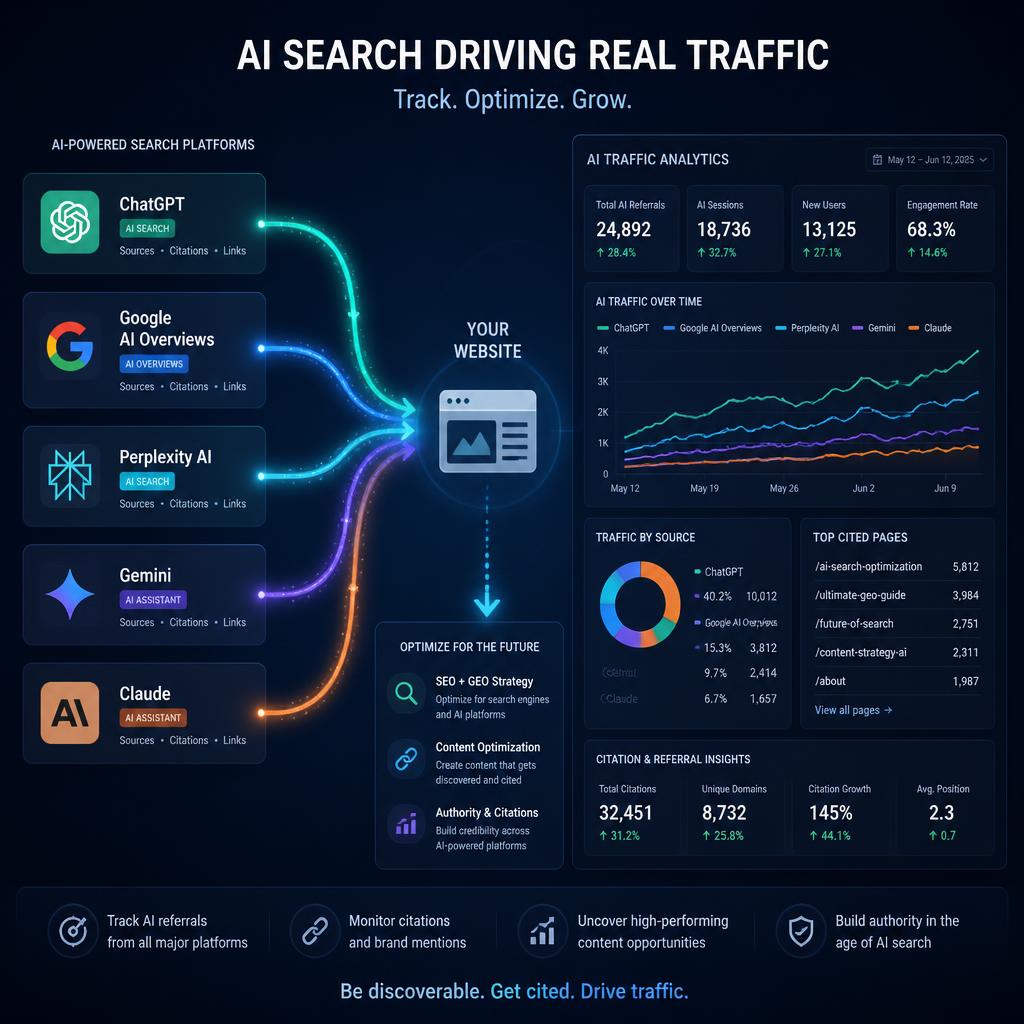
Measuring AI search traffic has become an important part of modern SEO and digital marketing. As users increasingly discover websites through ChatGPT, Google AI Overviews, Google AI Mode, Perplexity, Gemini, Copilot, and other AI-powered search experiences, traditional organic traffic reports no longer tell the complete story.
The challenge is that AI visibility is not the same as AI traffic. Your website can be cited in an AI-generated answer without receiving a click. A user can also discover your brand through an AI assistant, remember the name, and visit your website later through direct traffic or a branded Google search.
So how do you measure AI search traffic accurately?
The most reliable approach combines GA4 referral data, Google Search Console data, AI citation monitoring, brand-mention tracking, conversion data, and first-party attribution.
This guide explains how to measure AI search traffic in 2026, which metrics matter, what GA4 can and cannot track, and how to build a practical AI search measurement system.
AI Search Optimization Checklist 2026
Which is the best AI tool? – 2026
How do I check my Google SEO ranking?
Quick Answer: How Do You Measure AI Search Traffic?
To measure AI search traffic, combine several data sources rather than relying on one metric.
- Use Google Analytics 4 to identify measurable AI-assistant referrals.
- Track ChatGPT referrals using its identifiable referral information and UTM data.
- Monitor Google Search Console for organic visibility and branded-search changes.
- Track AI citations and mentions with dedicated AI visibility tools.
- Measure conversions and revenue from identifiable AI referrals.
- Use form questions and CRM data to capture AI-assisted discovery that analytics cannot identify.
- Track AI visibility separately from actual website visits.
The key distinction is:
AI visibility = how often your brand or content appears in AI answers.
AI traffic = users who actually visit your website from an AI platform.
AI-assisted conversions = conversions influenced by AI discovery, even when the final visit comes from another channel.
These three measurements should not be treated as the same thing.
What Is AI Search Traffic?
AI search traffic is website traffic generated when users discover and click through to a website from an AI-powered search or conversational platform.
Examples include clicks from:
- ChatGPT Search
- Perplexity
- Gemini
- Microsoft Copilot
- Google AI experiences
- Other AI assistants that provide clickable web sources
For example, imagine someone asks ChatGPT:
“What are the best websites for computer parts?”
ChatGPT provides several sources and links to your article. The user clicks your link and visits your website.
That session can be considered AI referral traffic.
However, if ChatGPT mentions your company but the user does not click, you received AI visibility, not measurable referral traffic.
This distinction is fundamental to AI search measurement.
Why Is AI Search Traffic Difficult to Measure?
Traditional search analytics were designed around a relatively simple journey:
Search → click → website → conversion
AI discovery can follow a much more complicated path:
AI answer → brand discovery → later Google search → website → conversion
Or:
AI citation → direct website visit → conversion
Or:
AI answer → no click
This creates several measurement problems.
AI Answers Can Generate Zero-Click Visibility
An AI system may answer a user’s question directly without requiring the user to visit your website.
Your content can therefore influence the user’s decision without generating a measurable session.
This is one reason traditional organic traffic alone cannot measure AI search performance. Semrush similarly distinguishes AI visibility from traffic because citations can increase visibility without producing a corresponding website session.
Referral Information Can Be Incomplete
GA4 uses traffic-source information to classify where sessions originate. When referral information is missing, traffic can end up classified as direct or otherwise lose the original source. Google notes that missing campaign information and other technical factors can contribute to (direct) / (none) traffic.
This means your analytics data can underestimate the influence of AI discovery.
Google AI Search Is Different From AI Assistants
Google’s AI experiences should not automatically be grouped with ChatGPT or Perplexity.
Google Analytics’ AI Assistant channel includes sources such as ChatGPT, Gemini, DeepSeek, Copilot, and Grok, while Google explicitly excludes Google AI Overviews and AI Mode from that channel.
Therefore, AI measurement requires multiple data sources.
The Most Important AI Search Metrics
Instead of creating one generic “AI score,” track several separate metrics.
1. AI Citations
An AI citation occurs when an AI-generated answer references or links to your website as a source.
Track:
- Number of citations
- Cited URLs
- Citing AI platforms
- Queries generating citations
- Citation frequency over time
- Competitors cited for the same queries
Citation data helps answer an important question:
Is AI search using my website as a source?
Dedicated AI visibility platforms can monitor citations across large prompt sets. For example, Semrush provides metrics for citations, cited pages, mentions, and visibility.
2. AI Mentions
A mention is different from a citation.
An AI system may mention your brand without linking to your website.
Track:
- Brand mentions
- Product mentions
- Brand recommendations
- Competitor mentions
- Changes in mentions over time
Mentions are especially useful for measuring brand visibility.
3. AI Referral Traffic
This is the most traditional traffic metric.
Measure:
- Sessions
- Users
- Landing pages
- Engagement
- Conversions
- Revenue
- Returning users
Google Analytics 4 provides traffic-source dimensions that allow marketers to analyze where visitors originate.
In 2026, GA4 also provides an AI Assistant default channel for traffic from supported AI assistants.
4. AI Conversion Rate
Traffic volume alone does not tell you whether AI discovery is valuable.
Calculate:
AI Conversion Rate = AI Conversions ÷ AI Sessions × 100
Track this separately for:
- ChatGPT
- Perplexity
- Gemini
- Copilot
- Other identifiable AI sources
Then compare the behavior with other acquisition channels.
Avoid using a universal conversion benchmark because conversion rates vary significantly by industry, landing page, offer, device, and conversion type.
5. AI Revenue
For ecommerce websites, track revenue associated with identifiable AI referral sessions.
A basic calculation is:
AI Revenue = Revenue from AI-attributed conversions
You can also calculate:
AI Revenue per Session = AI Revenue ÷ AI Sessions
This provides a more useful business metric than traffic volume alone.
6. AI Share of Voice
AI share of voice measures your visibility relative to competitors across a defined set of prompts.
For example, you could monitor 100 commercial queries and record:
- Your brand appearance
- Competitor A appearance
- Competitor B appearance
- Number of citations
- Citation position
AI visibility tools now provide these types of competitive measurements at much larger scales. Ahrefs, for example, reports AI visibility data across hundreds of millions of modeled prompts and multiple AI platforms.
7. Cited Pages
Don’t only measure how often your domain appears.
Identify which pages AI systems cite.
You may discover that:
- Guides generate most citations
- Product pages generate most conversions
- Comparison articles generate most mentions
- FAQ pages generate citations for informational queries
This information can guide your content strategy.

How to Track AI Search Traffic in GA4
Google Analytics 4 should be your primary source for measurable website sessions.
Go to:
Reports → Acquisition → Traffic acquisition
Google’s documentation explains that the Traffic acquisition report provides information about where website visitors come from and allows analysis using traffic-source dimensions.
Use the AI Assistant Channel
GA4’s current default channel grouping includes AI Assistant.
Google defines this channel as traffic arriving from AI sources such as ChatGPT, Gemini, DeepSeek, Copilot, and Grok. It does not include Google AI Overviews or AI Mode.
This makes the AI Assistant channel a useful starting point for measuring identifiable AI traffic.
Analyze Individual AI Sources
Do not stop at the combined channel.
Break traffic down by source where possible.
For example:
- chatgpt.com
- perplexity.ai
- gemini.google.com
- other identifiable AI platforms
Then compare:
- Sessions
- Engaged sessions
- Engagement rate
- Average engagement time
- Conversions
- Revenue
This tells you whether AI traffic is merely generating visits or producing meaningful business results.
How to Identify Hidden AI Traffic
Not every AI-driven website visit will appear as an obvious AI referral in analytics. Some users may discover a brand through an AI answer and return later through another channel.
This creates what can be described as hidden or indirect AI influence.
The goal is not to label every unexplained visit as AI traffic. Instead, combine several signals to identify potential AI-assisted discovery.
Check Direct Traffic Carefully
A sudden increase in (direct) / (none) traffic does not automatically mean that AI platforms generated those visits.
Direct traffic can have multiple causes, including users entering a URL manually, bookmarks, missing referral information, and other attribution limitations.
Therefore, direct traffic should be treated as a signal to investigate rather than proof of AI traffic.
Monitor AI Referral Sources
Review your referral and acquisition reports for identifiable AI platforms.
Depending on the platform and tracking configuration, you may see sources associated with services such as:
- ChatGPT
- Perplexity
- Gemini
- Copilot
- Other AI assistants
Create a dedicated view or segment for these sources so that AI traffic can be monitored consistently.
Use UTM Parameters When Available
UTM parameters can make campaign and referral analysis easier.
For example:
utm_source=chatgpt.com
When an AI platform provides identifiable campaign or referral parameters, preserve those parameters in your analytics system rather than removing them through redirects or tracking configurations.
Analyze Landing Pages
Look at which pages receive AI-related traffic.
AI visitors may disproportionately arrive on:
- How-to guides
- Product comparisons
- Reviews
- Buying guides
- Research articles
- FAQ pages
- Category pages
If a specific page receives identifiable AI traffic and also shows strong engagement or conversions, it may deserve additional optimization for AI search visibility.
Monitor Branded Search
AI discovery can create a delayed effect.
A user might see your company in an AI answer, remember the brand, and search for it on Google later.
Monitor changes in:
- Branded impressions
- Branded clicks
- Brand-name queries
- Direct traffic
- Returning users
These changes do not prove that AI caused the increase, but they can provide useful supporting evidence when combined with citation and mention data.
Ask Customers Directly
First-party surveys can help identify AI discovery that analytics cannot.
Consider adding:
“Did an AI assistant such as ChatGPT, Gemini, or Perplexity help you find us?”
This information can be stored alongside lead or customer data and compared with analytics attribution.
Combine the Signals
A practical hidden-AI analysis can combine:
AI citations + AI mentions + identifiable AI referrals + branded search trends + self-reported discovery
The objective is not to estimate an exact amount of “missing AI traffic” without evidence. Instead, these signals help identify where AI may be influencing discovery beyond what standard referral reports show.
How to Track ChatGPT Traffic
ChatGPT provides an especially useful measurement signal for publishers.
OpenAI states that referral URLs from ChatGPT Search automatically include:
utm_source=chatgpt.com
This allows website owners to identify and analyze referral traffic from ChatGPT in analytics platforms such as Google Analytics.
You should therefore monitor ChatGPT traffic separately from general referral traffic whenever your analytics setup allows it.
Track:
Source: ChatGPT
Landing page: The page receiving the visit
Sessions: Number of visits
Conversions: Completed goals
Revenue: Revenue attributed to those sessions
This provides a much clearer picture than simply counting AI citations.
Digital PR Strategy 2026: AI and Automation
AI Overviews Traffic Impact: 2026 Guide
How is AI transforming marketing in 2026?
How to Measure Google AI Overviews
Google AI Overviews require a different approach.
Do not assume that traffic appearing as google / organic represents traditional blue-link search only.
AI-powered Google search experiences can be part of the same broader Google ecosystem.
Google’s GA4 documentation specifically states that AI Overviews and AI Mode are excluded from the AI Assistant default channel.
Therefore, use:
- Google Search Console
- Google Analytics
- SEO platforms
- AI visibility tools
together when analyzing Google’s AI search ecosystem.
Search Console is particularly useful for analyzing:
- Impressions
- Clicks
- Queries
- Pages
- Search visibility
- Branded search trends
The important point is not to claim that every organic Google visit came from an AI Overview. Instead, look for changes in search performance alongside AI visibility data.
How to Measure Perplexity and Other AI Platforms
For platforms such as Perplexity and other AI assistants, start with referral-source analysis in GA4.
Look for identifiable referring domains and separate them into an AI traffic group.
Then measure:
AI platform → landing page → engagement → conversion → revenue
This lets you determine which AI platforms actually send users to your website.
However, referral traffic still represents only the clickable portion of your AI visibility.
A platform could cite your website frequently while sending relatively few clicks.
AI Traffic vs. AI Visibility
This is one of the most important concepts in AI SEO.
| Metric | What it measures |
|---|---|
| AI Mention | Brand appears in an AI response |
| AI Citation | Website/content is referenced as a source |
| AI Visibility | Overall presence across tracked AI queries |
| AI Referral Traffic | Users who click from AI to your site |
| AI Conversion | Visitors from AI who complete a goal |
| AI Revenue | Revenue associated with identifiable AI traffic |
These metrics answer different questions.
Visibility asks: Are AI systems showing us?
Traffic asks: Are users clicking?
Conversion asks: Are those visitors taking action?
Revenue asks: Is the channel producing measurable business value?
AI Search Measurement by Funnel Stage
AI search can influence users at different stages of the customer journey. Measuring only website visits therefore misses important parts of the funnel.
A better approach is to assign different AI metrics to different stages.
| Funnel Stage | What to Measure | Main Question |
|---|---|---|
| Discovery | AI mentions | Is the brand appearing in AI answers? |
| Visibility | AI citations | Are AI systems using the website as a source? |
| Consideration | Product and brand mentions | Is AI helping users evaluate the brand? |
| Visit | AI referral traffic | Are users clicking through to the website? |
| Engagement | Engaged sessions | Are AI visitors interacting with the site? |
| Conversion | Leads, sales, sign-ups | Are AI visitors taking action? |
| Revenue | AI-attributed revenue | Is AI generating measurable business value? |
| Retention | Returning users and customer value | Do AI-discovered users become valuable customers? |
Discovery
At the discovery stage, focus on mentions and brand visibility.
Track how frequently your brand appears when users ask relevant questions.
Visibility
At the visibility stage, monitor citations and cited URLs.
This shows whether AI systems are using your content as a source.
Consideration
During consideration, monitor whether AI platforms mention your products, services, features, or brand when users compare different options.
This can provide insight into how your content performs for commercial and comparison queries.
Website Visits
At the traffic stage, measure identifiable AI referrals.
Important metrics include:
- Sessions
- Users
- Landing pages
- New users
- Engaged sessions
Engagement
Traffic quality becomes more important once visitors reach the website.
Measure:
- Engagement rate
- Average engagement time
- Pages viewed
- Key events
- Returning visits
Compare these metrics with other acquisition channels.
Conversions
Track the actions that matter to your business.
Depending on the website, these might include:
- Purchases
- Lead submissions
- Newsletter registrations
- Account creation
- Demo requests
- Contact requests
- Downloads
Revenue
For ecommerce and lead-generation businesses, connect AI traffic with financial outcomes whenever possible.
Track:
AI sessions → conversions → revenue
This allows AI search to be evaluated as a business channel rather than simply a visibility channel.
Retention
The final stage is long-term customer value.
If AI-discovered visitors become repeat customers, their value may extend beyond the initial AI referral.
For this reason, returning users, repeat purchases, and customer lifetime value can provide additional insight into the quality of AI-assisted acquisition.
AI Search Attribution Model
Measuring AI search performance becomes more complicated when a user interacts with your brand through multiple channels before converting. A visitor may discover your website in an AI-generated answer, search for your brand on Google later, and finally return directly to complete a purchase.
For this reason, AI search attribution should not rely exclusively on the last recorded traffic source.
First-Click Attribution
First-click attribution gives credit to the first identifiable source that introduced the visitor to your website.
For example:
ChatGPT → Website → Google → Purchase
Under a first-click model, ChatGPT receives credit for introducing the user to the website.
This can help reveal the role AI search plays in initial discovery.
Last-Click Attribution
Last-click attribution gives credit to the channel responsible for the final measurable visit before conversion.
Using the same example:
ChatGPT → Website → Google → Purchase
Google would receive the conversion credit if the final visit came from Google.
This approach is useful for measuring immediate conversion performance, but it can underestimate the influence of earlier AI discovery.
Assisted Conversions
Assisted attribution recognizes that multiple channels can contribute to a conversion.
For example:
AI discovery → branded Google search → website → purchase
In this scenario, AI search may have influenced the customer even though Google generated the final measurable visit.
Tracking assisted conversions provides a broader view of AI’s role in the customer journey.
Self-Reported Attribution
Another useful method is asking customers how they discovered your brand.
A checkout form, lead form, or post-purchase survey can include a question such as:
“How did you first hear about us?”
Possible answers can include:
- Google Search
- ChatGPT or another AI assistant
- Social media
- YouTube
- Recommendation
- Blog or article
- Other
Self-reported attribution can capture AI discovery that traditional analytics cannot identify reliably.
Why Multi-Touch Attribution Matters for AI Search
AI search often functions as a discovery channel rather than the final conversion channel.
Therefore, businesses should compare:
- First-touch AI conversions
- Last-touch AI conversions
- Assisted AI conversions
- Self-reported AI discovery
- Direct AI referral conversions
No single attribution model provides a complete picture. Using several attribution signals together gives marketers a more realistic understanding of how AI search contributes to the customer journey.
Tools for Measuring AI Search Performance
A strong measurement system normally combines analytics with AI visibility monitoring.
Google Analytics 4
Use GA4 for:
- AI referral sessions
- Engagement
- Conversions
- Revenue
- Landing pages
- User journeys
Google Search Console
Use Search Console for:
- Google search impressions
- Clicks
- Queries
- Pages
- Branded search trends
Semrush
Semrush’s AI Visibility Toolkit provides metrics including AI visibility, mentions, citations, cited pages, sources, and missing prompts.
Ahrefs
Ahrefs provides AI visibility and citation analysis across multiple AI search environments and uses large prompt datasets to benchmark brand visibility.
Manual AI Testing
Manual testing remains useful because automated scores can hide important context.
Create a fixed list of important prompts and test them regularly.
For example:
- 25 informational queries
- 25 commercial queries
- 25 comparison queries
- 25 problem-solving queries
Record:
- Whether your brand appears
- Whether your domain is cited
- Which page is cited
- Citation position
- Competitors appearing
- Accuracy of the information
Repeat the same methodology each month.
How to Build an AI Search Measurement Dashboard
A practical dashboard can contain five sections.
Section 1: AI Visibility
Track:
- Mentions
- Citations
- Cited pages
- Share of voice
- Visibility trend
Section 2: AI Traffic
Track:
- AI sessions
- Users
- Landing pages
- Engagement
- New users
Section 3: Conversions
Track:
- Leads
- Purchases
- Sign-ups
- Conversion rate
- Revenue
Section 4: Competitive Visibility
Track:
- Your citations
- Competitor citations
- Shared prompts
- Missing prompts
- Changes over time
Section 5: Brand Search
Monitor branded queries in Google Search Console.
An increase in branded searches can provide additional evidence that people are becoming more familiar with your brand, although it cannot by itself prove that AI search caused the increase. Semrush recommends examining branded search trends alongside AI visibility rather than treating referral traffic as the only signal.
A Practical AI Traffic Measurement Process
Step 1: Establish Your Baseline
Record your current:
- AI referrals
- AI citations
- AI mentions
- branded searches
- conversions
- revenue
This gives you a starting point.
Step 2: Create a Prompt Set
Build a consistent list of questions relevant to your business.
Include:
- Informational queries
- Commercial queries
- Comparison queries
- Product queries
- Local queries
- Problem-solving queries
Use the same core prompts when measuring changes.
Step 3: Configure GA4
Verify that:
- GA4 is installed correctly
- Traffic acquisition reports are working
- AI Assistant traffic is visible
- conversions are configured
- revenue tracking is working
Also inspect referral sources that may not be grouped exactly as expected.
Step 4: Track AI Citations
Use an AI visibility platform or structured manual testing.
Record:
Prompt → AI platform → brand mention → citation → cited URL → competitor → position
Step 5: Connect Traffic to Business Outcomes
Don’t stop at sessions.
Measure:
AI traffic → engagement → lead/purchase → revenue
This transforms AI SEO from a visibility exercise into a measurable marketing channel.
How to Improve AI Search Measurement Accuracy
Don’t Treat Every Direct Visit as AI Traffic
A rise in direct traffic does not prove that AI caused it.
Direct traffic can result from many sources, including users typing a URL, bookmarks, missing referral information, and other situations. Google documents several reasons traffic can appear as (direct) / (none).
Don’t Treat Citations as Clicks
A citation indicates that your content was used or referenced in an AI response.
It does not automatically mean someone visited your website.
Don’t Compare Different Prompt Sets
If you measure 50 prompts in January and 500 completely different prompts in February, changes in visibility may simply reflect the different dataset.
Keep a stable core prompt set.
Don’t Focus Only on Traffic Volume
A smaller amount of AI traffic with strong engagement and conversions can be more meaningful than a large volume of low-quality sessions.
Measure business outcomes alongside traffic.
What Should You Report Each Month?
A simple monthly AI search report can include:
| Category | Metrics |
|---|---|
| Visibility | Mentions, citations, visibility |
| Content | Cited pages, top cited URLs |
| Traffic | AI sessions, users, landing pages |
| Engagement | Engaged sessions, engagement rate |
| Conversion | Leads, purchases, conversion rate |
| Revenue | AI-attributed revenue |
| Brand | Branded-search impressions/clicks |
| Competition | Share of voice, competitor citations |
| Opportunities | Missing prompts and uncovered topics |
This creates a much more complete picture than reporting AI traffic alone.
AEO vs GEO vs SEO: Complete Comparison 2026
Frequently Asked Questions
Can Google Analytics measure AI search traffic?
Yes. GA4 can identify some AI-assistant traffic, and its current default channel grouping includes an AI Assistant channel for sources such as ChatGPT, Gemini, DeepSeek, Copilot, and Grok. Google AI Overviews and AI Mode are excluded from this channel.
Can ChatGPT traffic be tracked in GA4?
Yes. OpenAI states that ChatGPT Search referral URLs automatically include utm_source=chatgpt.com, which can help publishers identify ChatGPT referrals in analytics systems.
Does AI visibility mean AI traffic?
No. AI visibility measures whether your brand or content appears in AI-generated responses. AI traffic measures users who actually visit your website from an AI platform.
How do I track AI citations?
Use a dedicated AI visibility platform or a consistent manual prompt-testing methodology. Track the AI platform, query, citation, cited URL, and competitor results over time.
Can I measure Google AI Overview traffic separately?
Not simply through GA4’s AI Assistant channel. Google explicitly excludes AI Overviews and AI Mode from that channel, so Google’s AI search visibility should be analyzed using Google search data alongside AI visibility tools and other signals.
What is the most important AI search metric?
There is no single metric that captures the entire AI search journey. A useful measurement framework combines citations, mentions, visibility, referral traffic, conversions, and revenue.
How to Calculate AI Search ROI
Measuring AI search traffic is useful, but businesses ultimately need to understand whether their investment in AI SEO produces measurable value.
A basic AI search ROI formula is:
AI Search ROI = (AI-attributed revenue − AI search costs) ÷ AI search costs × 100
AI search costs may include:
- Content creation
- SEO software
- AI visibility platforms
- Content optimization
- Digital PR
- Technical SEO
- Content updates
- Internal marketing resources
Direct AI ROI
Direct AI ROI measures revenue from identifiable AI referral traffic.
For example:
AI referral → website → purchase
If the AI source can be identified and the purchase is attributed to that session, the resulting revenue can be included in direct AI revenue.
Assisted AI ROI
Assisted AI ROI is more difficult to measure but can be important.
Consider this journey:
ChatGPT → brand discovery → Google search → website → purchase
Google may receive the final click attribution, while AI search played an earlier role in discovery.
For this reason, businesses should consider assisted conversions and first-party attribution alongside direct referral revenue.
Calculate AI Revenue Per Session
Another useful metric is:
AI Revenue Per Session = AI-attributed revenue ÷ AI sessions
This helps compare the economic value of AI traffic with other acquisition channels.
For example, a website might discover that AI traffic produces fewer sessions than organic search but generates stronger revenue per session.
Calculate Cost Per AI Acquisition
For businesses with measurable conversions:
AI Customer Acquisition Cost = AI search investment ÷ AI-acquired customers
This can help determine whether investment in AI visibility and content is producing customers at an acceptable cost.
Don’t Measure ROI From Citations Alone
A citation is not revenue.
A website can receive hundreds of AI citations without generating an equivalent number of visits or conversions.
Therefore, AI ROI should connect multiple layers:
AI visibility → AI traffic → engagement → conversions → revenue
For long customer journeys, add:
AI discovery → assisted conversion → customer value
Use a Consistent Measurement Period
Compare AI performance over consistent periods such as:
- Month over month
- Quarter over quarter
- Year over year
Keep the tracked prompt set, conversion definitions, and attribution methodology consistent whenever possible.
This makes changes easier to interpret and reduces the risk of confusing measurement changes with actual performance changes.
Conclusion
Measuring AI search traffic in 2026 requires a broader framework than traditional SEO analytics.
AI search creates several layers of visibility:
AI mention → AI citation → website visit → conversion → revenue
Each stage should be measured separately.
GA4 is useful for identifying measurable AI referral traffic, while Google Search Console helps analyze Google’s search ecosystem. AI visibility platforms can measure citations, mentions, cited pages, and competitive visibility at scale. OpenAI also provides a clear referral signal for ChatGPT through utm_source=chatgpt.com.
The most effective measurement strategy therefore does not ask only:
“How much traffic did AI send us?”
It also asks:
“How often are we visible in AI answers, which pages are being cited, how many users click, what do they do after arriving, and what business value does that visibility create?”