Link Building Mistakes to Avoid in 2026: Updated Guide
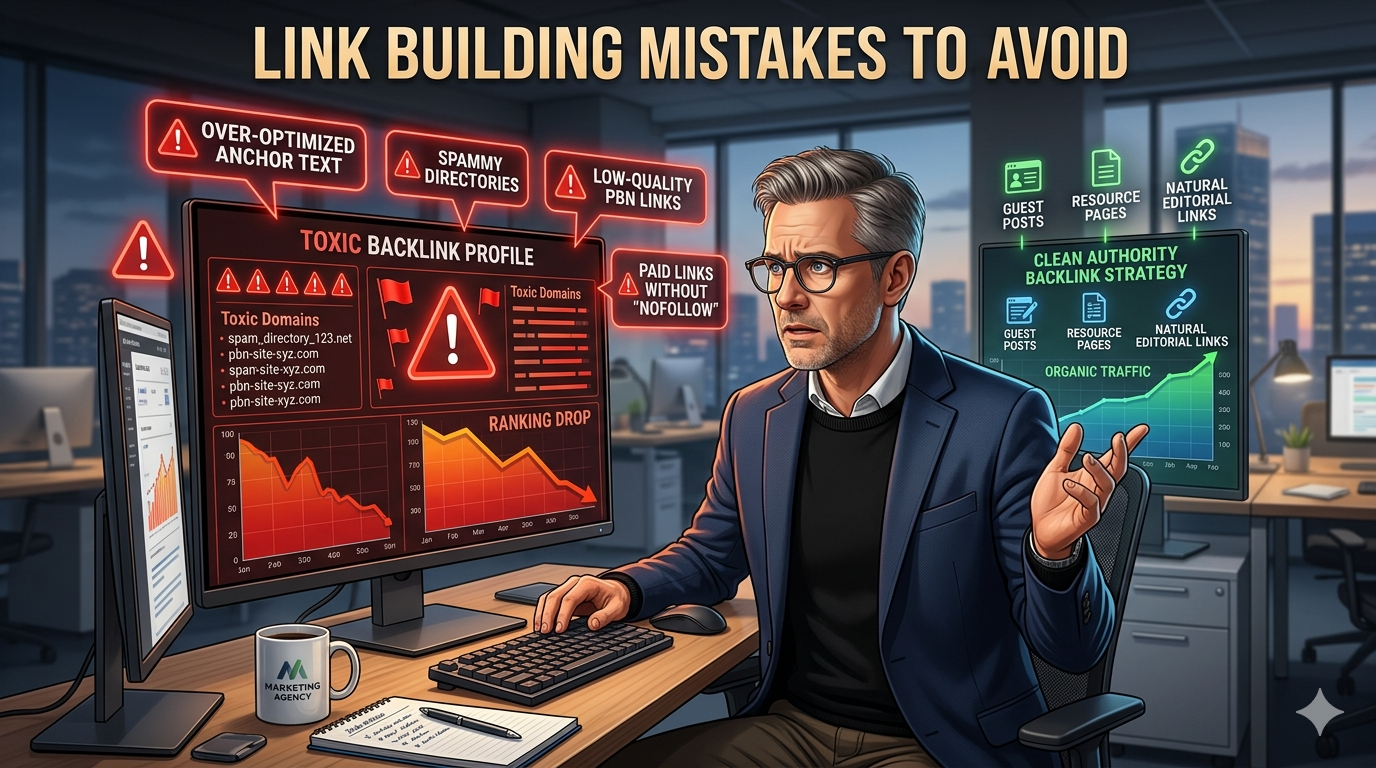
Link building mistakes in 2026 are more sophisticated and harder to detect than ever before. While old-school link spam is still penalized, new mistakes have emerged as AI and automation have become prevalent. This comprehensive guide reveals the most critical link building mistakes to avoid in 2026 and how to build a sustainable, penalty-free link profile.
Critical Link Building Mistakes in 2026
Mistake 1: Over-Relying on AI Without Human Oversight
While AI tools are powerful, blindly trusting them can lead to disasters:
- AI-generated outreach can miss nuance and context
- Automated systems may target irrelevant sites
- AI can misinterpret relationship signals
- Lack of human judgment leads to poor decisions
- AI may miss cultural or industry-specific nuances
- Automated systems can damage relationships
- Over-automation reduces personalization
- AI errors can compound at scale
Best practice: Use AI for research and optimization, but maintain human oversight for all outreach and relationship building. AI should enhance human decision-making, not replace it.
Mistake 2: Ignoring Topical Relevance
In 2026, topical relevance is more important than ever. Mistakes include:
- Getting links from completely unrelated sites
- Ignoring semantic relevance
- Focusing only on domain authority
- Building links without considering topic clusters
- Accepting links from off-topic content
- Ignoring content context
- Not considering audience relevance
- Building links across unrelated topics
A link from a highly relevant site with lower authority is now worth more than a link from an unrelated high-authority site. Google’s semantic understanding has made relevance a primary ranking factor.
AI Overviews Traffic Impact: 2026 Guide
Best Content Formats for AI Citations in 2026
Mistake 3: Artificial Link Velocity Patterns
Search engines in 2026 closely monitor link acquisition patterns. Mistakes include:
- Sudden spikes in link acquisition
- Unnatural link growth patterns
- Acquiring too many links too quickly
- Inconsistent link building activity
- Buying links in bulk
- Using automated link building services
- Sudden changes in link acquisition rate
- Unnatural anchor text distribution
Sustainable, gradual link building is now essential for avoiding penalties. Google can easily identify unnatural link patterns.
Mistake 4: Neglecting Link Maintenance
In 2026, link building doesn’t end after acquiring links. Mistakes include:
- Not monitoring link status and health
- Ignoring broken or removed links
- Failing to update content to maintain link relevance
- Not reinforcing relationships with link sources
- Ignoring link decay over time
- Not replacing lost links
- Failing to maintain link portfolio
- Ignoring relationship maintenance
Active link maintenance is now essential for long-term SEO success. Links require ongoing attention and relationship management.
Mistake 5: Using Outdated Anchor Text Strategies
Anchor text strategy has evolved significantly by 2026. Mistakes include:
- Over-optimizing anchor text with exact keywords
- Using unnatural anchor text variations
- Ignoring natural language patterns
- Failing to diversify anchor text appropriately
- Using keyword-stuffed anchor text
- Ignoring brand anchor text
- Using generic anchor text exclusively
- Creating unnatural anchor text patterns
Natural, contextual anchor text is now the standard. Google can detect unnatural anchor text patterns and may penalize them.
Mistake 6: Ignoring Link Context and Placement
Where a link appears matters significantly in 2026. Mistakes include:
- Accepting links in sidebars or footers
- Ignoring link placement quality
- Not considering surrounding content
- Accepting links outside main content
- Accepting links in comment sections
- Ignoring editorial context
- Accepting low-quality placements
- Not verifying link visibility
Links in editorial content with proper context are now valued much higher. Poor placement can actually harm your link profile.
Mistake 7: Building Links Without Considering User Experience
In 2026, user experience is a ranking factor. Mistakes include:
- Building links that don’t provide value to users
- Ignoring referral traffic quality
- Not considering audience alignment
- Focusing only on search engine metrics
- Ignoring user engagement signals
- Not measuring conversion impact
- Ignoring traffic quality metrics
- Prioritizing quantity over quality
Links that drive engaged, relevant traffic are now prioritized. User experience signals have become increasingly important ranking factors.
Mistake 8: Ignoring Emerging Link Fraud Detection
Link fraud detection has become sophisticated in 2026. Mistakes include:
- Using link networks or PBNs
- Buying links from suspicious sources
- Participating in link schemes
- Using automated link building services
- Participating in link exchanges
- Using link wheels or pyramids
- Buying expired domains for links
- Using link farms or networks
Google’s detection systems in 2026 can identify link fraud with high accuracy. Penalties for link schemes are severe and long-lasting.
2026-Specific Link Building Mistakes
Mistake 9: Misusing AI Tools
New mistakes specific to 2026 include:
- Using AI-generated content for link attraction without human review
- Relying on predictive analytics without validation
- Automating all outreach without personalization
- Ignoring AI-generated insights that don’t align with strategy
- Over-trusting AI predictions
- Using AI without understanding its limitations
- Automating relationship building
- Ignoring human judgment in AI decisions
Mistake 10: Ignoring Blockchain Link Verification
As blockchain verification becomes standard, mistakes include:
- Not verifying link authenticity
- Ignoring blockchain-verified link signals
- Using unverified link sources
- Not understanding blockchain implications for link building
- Ignoring trust signal importance
- Using low-trust link sources
How to Avoid These Mistakes
Implement Comprehensive Link Audits
Regular audits help identify and fix mistakes:
- Monthly link profile reviews
- Topical relevance assessment
- Link quality evaluation
- Velocity pattern analysis
- Anchor text analysis
- Traffic quality assessment
- Competitor comparison
- Risk identification
Maintain Human Oversight
Always maintain human judgment in link building:
- Review AI recommendations
- Personalize outreach
- Build genuine relationships
- Make strategic decisions
- Validate AI insights
- Apply industry knowledge
Focus on Sustainable Growth
Build links for long-term success:
- Gradual, natural link growth
- Quality over quantity
- Relevant, topical links
- Active link maintenance
- Relationship building
- Content excellence
High-Quality Backlinks 2026: New Standards
Competitor Backlink Analysis Tutorial
What Makes a High-Quality Backlink? 2026
Conclusion
Link building mistakes in 2026 are more subtle and sophisticated than ever before. By understanding these mistakes and implementing best practices, you can build a sustainable, high-quality link profile that drives long-term SEO success without risking penalties.