Modern Link Building Strategies 2026: AI-Powered Approach & Automation

Link building remains one of the most important ranking factors in search engine optimization. While Google’s algorithms have evolved significantly over the past decade, backlinks continue to serve as powerful trust signals that help search engines determine which content deserves visibility.
However, link building in 2026 looks very different from what it did just a few years ago. Traditional tactics such as mass guest posting, directory submissions, and generic outreach campaigns have lost much of their effectiveness. Modern link building focuses on authority, relevance, brand recognition, user value, and strategic relationship building.
At the same time, artificial intelligence has transformed how marketers identify opportunities, analyze competitors, personalize outreach, and predict content performance. Successful SEO professionals now combine human expertise with advanced automation to create scalable and sustainable backlink acquisition strategies.
This guide explores the most effective link building methods in 2026, explains which tactics continue to work, and shows how businesses can build strong backlink profiles that generate long-term rankings, traffic, and revenue.
Why Link Building Still Matters
Despite countless algorithm updates, backlinks remain one of the strongest signals used by search engines to evaluate authority and trust.
When authoritative websites link to your content, they effectively endorse your expertise. These endorsements help search engines understand that your content provides value and deserves higher visibility in search results.
Quality backlinks contribute to:
- Higher keyword rankings
- Increased organic traffic
- Better domain authority
- Improved topical authority
- Enhanced brand credibility
- More referral traffic
- Stronger search visibility
A website with a strong backlink profile typically has a significant advantage over competitors with similar content but weaker authority.
The key difference in 2026 is that quality matters more than quantity. A handful of highly relevant editorial backlinks often provide greater value than hundreds of low-quality links.
The Evolution of Link Building
In the early years of SEO, link building was largely a numbers game. Many marketers focused on acquiring as many links as possible regardless of quality.
Search engines eventually became better at identifying manipulation. Updates targeting spammy link practices dramatically reduced the effectiveness of low-quality backlinks.
Today, successful link building focuses on earning links through value creation rather than direct acquisition.
Google increasingly rewards links that are:
- Editorially earned
- Contextually relevant
- Topically related
- Naturally placed
- Helpful to users
- Supported by strong content
As a result, the best link building strategies now overlap heavily with content marketing, public relations, brand building, and audience development.
Building a Foundation for Successful Link Acquisition
Before investing time in outreach or promotion, businesses must establish a foundation that naturally attracts links.
Create Exceptional Content
The most successful link building campaigns begin with outstanding content.
Content that attracts links often includes:
- Original research
- Industry surveys
- Case studies
- Comprehensive guides
- Interactive tools
- Statistics pages
- Educational resources
People link to content that helps them support their own articles, educate their audiences, or reference reliable information.
Develop Topical Authority
Search engines increasingly evaluate expertise at the topic level.
Publishing dozens of unrelated articles is less effective than building comprehensive coverage around core subjects.
For example, an SEO website should consistently cover:
- Keyword research
- Link building
- Technical SEO
- On-page SEO
- Content optimization
Strong topical authority improves rankings and increases the likelihood of earning backlinks naturally.
Strengthen Brand Recognition
Brands attract links more easily than unknown websites.
Building visibility through social media, podcasts, interviews, webinars, and industry participation increases trust and encourages publishers to reference your content.
A recognizable brand often receives links without active outreach.
Digital PR: The Most Powerful Link Building Strategy in 2026
Digital PR has become one of the most effective methods for acquiring high-authority backlinks.
Instead of asking websites for links, digital PR focuses on creating stories that journalists and publishers genuinely want to cover.
Successful digital PR campaigns often involve:
- Original data
- Industry research
- Consumer surveys
- Trend reports
- Expert commentary
Journalists constantly need credible sources and fresh information.
When your content provides valuable insights, backlinks become a natural outcome of media coverage.
For example, a survey revealing changing consumer behavior may generate coverage from dozens of publications, resulting in multiple authoritative backlinks from a single campaign.
Original Research and Data Studies
Few content formats generate links more consistently than original research.
Writers, journalists, bloggers, and industry analysts frequently reference unique data when creating content.
Examples include:
- Market research reports
- Industry benchmarks
- Annual surveys
- Consumer behavior studies
- Performance comparisons
Publishing exclusive statistics creates opportunities for continuous backlink acquisition over time.
Many of the most linked pages on the internet are data-driven resources that become reference points for entire industries.
Statistics Pages
Statistics pages remain one of the easiest ways to earn backlinks at scale.
Content creators constantly search for reliable data to support their articles.
Creating regularly updated statistics pages allows your website to become a trusted reference source.
Examples include:
- SEO Statistics 2026
- Ecommerce Statistics
- Digital Marketing Statistics
- AI Industry Statistics
- Social Media Statistics
When maintained properly, these pages can generate backlinks for years with minimal additional effort.
Resource Page Link Building
Resource pages continue to provide valuable opportunities.
Many organizations maintain pages that list useful tools, educational resources, and recommended websites.
Finding relevant resource pages and demonstrating how your content benefits their audience can result in highly relevant backlinks.
Success depends on providing genuine value rather than simply requesting inclusion.
The best resource page opportunities align closely with your niche and target audience.
Competitor Backlink Analysis
One of the fastest ways to discover opportunities is analyzing competitor backlink profiles.
Competitor research helps identify:
- Websites linking to similar businesses
- Industry publications
- Resource pages
- Guest posting opportunities
- Editorial mentions
By understanding where competitors earn links, businesses can prioritize proven opportunities rather than starting from scratch.
The goal is not simply to copy competitors but to improve upon their approach with stronger content and better outreach.
Strategic Guest Posting
Guest posting remains effective when approached correctly.
The problem is not guest posting itself but low-quality execution.
Successful guest posting focuses on:
- Relevant websites
- Real audiences
- Expert insights
- Valuable content
- Long-term relationships
Publishing high-quality articles on respected industry websites can generate referral traffic, authority, and brand awareness in addition to backlinks.
The emphasis should always be on contributing value rather than obtaining links.
Expert Roundups
Expert roundups remain powerful because they combine content creation with relationship building.
By gathering insights from industry professionals, businesses create content that participants are likely to share and reference.
Benefits include:
- Increased authority
- Greater reach
- Social visibility
- Natural backlinks
- Industry connections
Featuring recognized experts can significantly improve content credibility and attract additional links.
Linkable Assets
A linkable asset is a piece of content specifically designed to attract backlinks.
Examples include:
- Calculators
- Templates
- Checklists
- Interactive tools
- Free resources
- Industry reports
These assets often generate links more consistently than standard blog posts because they provide direct practical value.
Many SaaS companies generate thousands of backlinks through free tools alone.
Using Artificial Intelligence in Link Building
Artificial intelligence has transformed the research and planning stages of link building.
AI can help identify:
- Content gaps
- Trending topics
- Outreach opportunities
- Competitor weaknesses
- Potential link prospects
It can also assist with:
- Outreach personalization
- Content ideation
- Data analysis
- Performance forecasting
However, AI should support human decision-making rather than replace it.
The strongest relationships, partnerships, and editorial opportunities still rely heavily on genuine human interaction.
Link Building Automation
Automation improves efficiency when applied responsibly.
Modern automation can help:
- Organize outreach campaigns
- Manage prospect databases
- Track responses
- Monitor backlinks
- Identify lost links
The objective is to eliminate repetitive tasks while preserving authenticity.
Automated spam campaigns remain ineffective and risky.
Measuring Link Building Success
Effective campaigns require accurate measurement.
Important metrics include:
- Referring domains
- Organic traffic growth
- Keyword rankings
- Referral traffic
- Conversion rates
- Revenue impact
Businesses increasingly evaluate link building based on ROI rather than link counts alone.
A campaign generating qualified leads and revenue is far more valuable than one producing hundreds of low-impact backlinks.
Common Mistakes to Avoid
Many businesses fail because they:
- Prioritize quantity over quality
- Buy low-quality backlinks
- Ignore relevance
- Use aggressive anchor text
- Neglect relationship building
- Publish weak content
- Fail to monitor results
Sustainable growth requires patience, consistency, and long-term thinking.
Future Trends
Looking ahead, several trends will continue shaping link building:
- Greater emphasis on brand authority
- Increased use of AI-assisted research
- Stronger focus on topical relevance
- More sophisticated spam detection
- Greater integration between SEO and digital PR
- Increased importance of original research
Organizations that combine exceptional content, strong relationships, and data-driven decision-making will maintain a competitive advantage.
Conclusion
Link building in 2026 is no longer about acquiring as many backlinks as possible. It is about earning trust, authority, and recognition through valuable content and meaningful relationships.
Businesses that focus on quality, relevance, user value, and long-term brand development will continue to earn powerful backlinks naturally. By combining proven SEO fundamentals with modern technologies and strategic outreach, companies can build sustainable backlink profiles that drive rankings, traffic, and business growth for years to come.
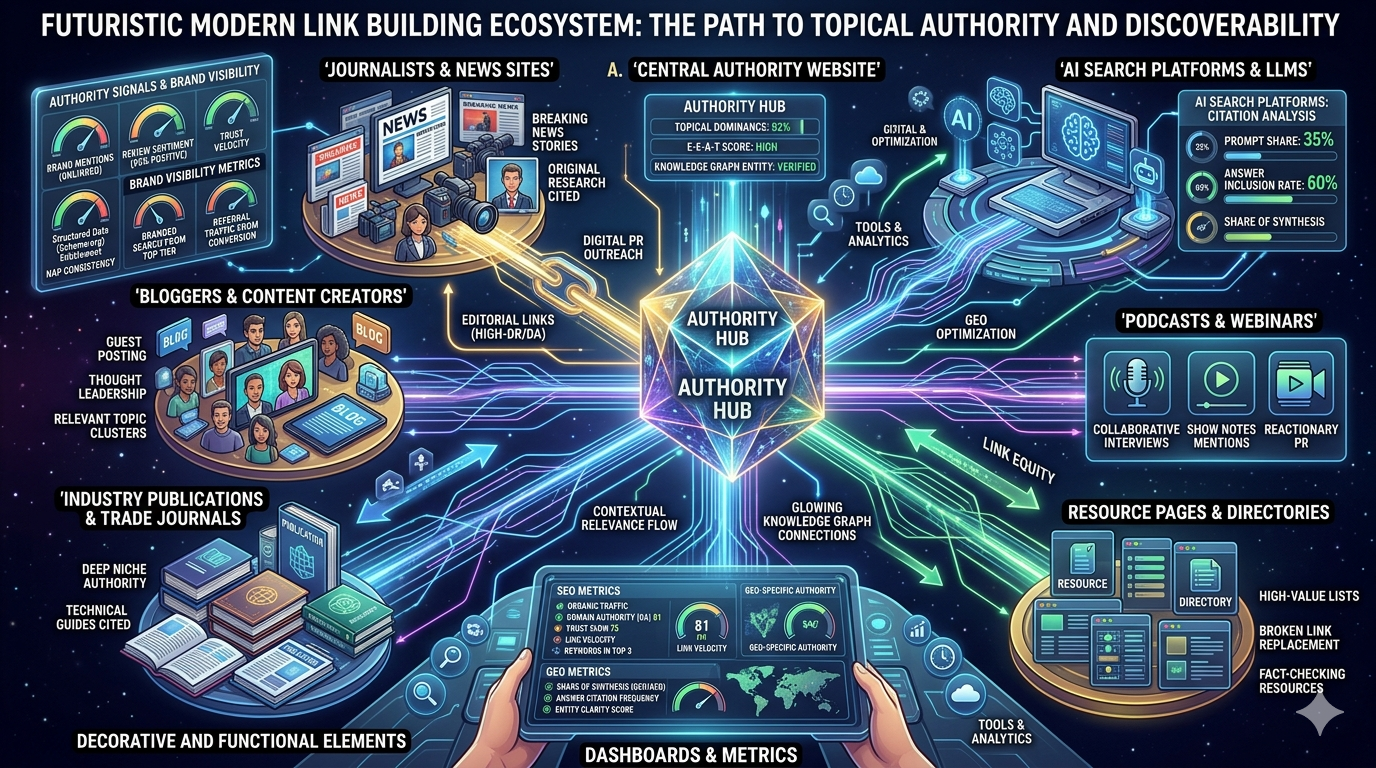
Real Link Building Case Studies
One of the biggest mistakes marketers make is focusing exclusively on tactics while ignoring real-world execution. Understanding how successful campaigns generate backlinks provides valuable insights that can be applied across industries.
Case Study 1: Industry Statistics Page
A software company launched a comprehensive industry statistics page containing more than 150 verified statistics collected from public studies, surveys, and market reports.
Instead of creating another standard blog post, the company built a resource specifically designed to help journalists, bloggers, researchers, and content creators find reliable data in one location.
The page included:
- Current industry statistics
- Historical growth trends
- Consumer behavior data
- Market forecasts
- Visual charts and graphs
Within six months, the page earned dozens of backlinks from blogs, news sites, and industry publications.
Why did it work?
Because writers constantly need statistics to support their content. Rather than searching through multiple sources, they preferred linking to a single comprehensive resource.
The lesson is simple: become the source that others reference.
Case Study 2: Original Survey Campaign
A digital marketing agency surveyed hundreds of marketers about SEO budgets, content strategies, and AI adoption.
The collected data was transformed into:
- A detailed report
- Infographics
- Press releases
- Social media assets
The survey revealed several surprising findings that generated industry discussion.
Because the information was unique, publishers could not obtain it elsewhere.
As a result, numerous industry websites linked to the report while discussing the findings.
This demonstrates why original data remains one of the strongest link magnets available.
Case Study 3: Interactive Tool Strategy
A finance website launched a free budgeting calculator designed to help users estimate monthly savings.
The tool solved a specific problem for its audience and required only a few inputs.
Because it provided immediate value, bloggers and publishers frequently recommended it to readers.
Over time, the calculator accumulated backlinks naturally without aggressive outreach.
The lesson is that useful tools often attract links more consistently than informational articles.
Case Study 4: Digital PR Campaign
A company analyzed public industry data and identified a growing trend affecting consumers.
Instead of publishing a generic blog post, they transformed the findings into a newsworthy story.
The campaign included:
- Data analysis
- Expert commentary
- Visual assets
- Media outreach
Journalists covering the topic cited the research and linked to the source.
The campaign generated multiple high-authority editorial links while also increasing brand awareness.
AI Overviews Traffic Impact: 2026 Guide
Best Content Formats for AI Citations in 2026
Case Study 5: Competitor Link Gap Strategy
A website analyzed competitors and discovered that many backlinks originated from industry resource pages.
Rather than copying competitors directly, the company created a superior resource that offered more detailed information and better user experience.
Website owners were contacted and introduced to the updated resource.
Because it genuinely improved the value available to users, many websites replaced older recommendations with the new content.
This approach demonstrated how improving existing resources can create strong link acquisition opportunities.
Advanced Link Building ROI & Analytics
Building links without measuring performance is like investing money without tracking returns.
Modern SEO teams evaluate backlinks using business metrics rather than vanity metrics.
Understanding Link Building ROI
ROI stands for Return on Investment.
The formula is:
ROI = (Revenue Generated – Campaign Cost) ÷ Campaign Cost × 100
If a company spends $5,000 on content creation and outreach and generates $25,000 in revenue from improved organic traffic, the ROI is:
(25,000 – 5,000) ÷ 5,000 × 100 = 400%
This means every dollar invested produced four dollars in profit.
Metrics That Matter in 2026
Many marketers still focus on metrics that have limited business value.
More useful measurements include:
- Revenue generated
- Organic traffic growth
- Qualified leads
- Conversion rates
- Customer acquisition cost
- Customer lifetime value
These metrics connect SEO efforts directly to business outcomes.
Revenue Per Link
One useful metric is Revenue Per Link.
Formula:
Revenue Per Link = Total Revenue Generated ÷ Number of Acquired Links
For example:
- 50 links acquired
- $50,000 revenue generated
Revenue Per Link = $1,000
This helps identify which campaigns create the highest value.
Link Lifetime Value
Backlinks often continue generating value for years.
Instead of measuring only short-term performance, marketers increasingly calculate Link Lifetime Value.
A backlink that contributes to rankings and traffic for five years may generate far more value than initially expected.
For example:
Year 1 Revenue: $500
Year 2 Revenue: $450
Year 3 Revenue: $400
Year 4 Revenue: $350
Year 5 Revenue: $300
Total Link Lifetime Value: $2,000
This demonstrates why investing in high-quality links often produces long-term returns.
Measuring Referral Traffic
Not all backlinks exist solely for SEO benefits.
Some links drive direct visitors.
Track:
- Referral sessions
- User engagement
- Time on page
- Bounce rate
- Conversion rate
A backlink that generates qualified traffic can deliver immediate business value.
Attribution Models
Modern customer journeys are complex.
Users may discover a brand through multiple channels before converting.
Common attribution models include:
First-Touch Attribution
Credits the first interaction.
Useful for measuring awareness.
Last-Touch Attribution
Credits the final interaction before conversion.
Useful for evaluating closing channels.
Linear Attribution
Distributes credit across every touchpoint.
Useful for longer customer journeys.
Data-Driven Attribution
Uses machine learning to assign value based on historical performance.
Many marketers now prefer this approach because it reflects real user behavior more accurately.
Competitive Benchmarking
Understanding your performance relative to competitors provides important context.
Compare:
- Referring domains
- Authority levels
- Traffic growth
- Link velocity
- Keyword visibility
This analysis helps identify opportunities and weaknesses.
How does AI help with online shopping? – 2026
How AI Supercharges Online Sales in 2026
Link Velocity Analysis
Link velocity refers to the rate at which backlinks are acquired.
Natural growth patterns vary by industry.
Sudden spikes can sometimes appear suspicious if unsupported by content popularity or publicity.
Healthy link acquisition generally reflects consistent growth driven by valuable content and brand visibility.
Anchor Text Optimization
Anchor text remains important but should appear natural.
Healthy profiles typically include:
- Brand anchors
- URL anchors
- Generic anchors
- Partial match anchors
- Contextual phrases
Over-optimization increases risk and reduces naturalness.
Lost Link Recovery
Many websites overlook lost backlinks.
Monitoring backlink profiles helps identify:
- Removed links
- Broken pages
- Website redesign issues
- Content changes
Recovering lost links is often easier than acquiring new ones.
Regular audits should be part of every link building strategy.
Building a Link Building Dashboard
A complete dashboard should include:
SEO Metrics
- Referring domains
- Backlink growth
- Keyword rankings
- Organic traffic
Business Metrics
- Leads generated
- Revenue impact
- Conversion rates
- Customer value
Performance Metrics
- Outreach success rates
- Link acquisition costs
- Referral traffic
- Content performance
Combining these metrics provides a complete view of campaign effectiveness.
Final Thoughts
Link building in 2026 is no longer about collecting backlinks through outdated tactics. Successful campaigns combine exceptional content, digital PR, strategic outreach, original research, relationship building, and advanced analytics.
The websites achieving the strongest organic growth are those that focus on creating genuine value. They publish resources worth citing, build relationships worth maintaining, and measure results based on real business outcomes.
As search engines continue evolving, the principles behind successful link building remain remarkably consistent: create something valuable, promote it effectively, earn trust, and become a source that others naturally want to reference.
Businesses that embrace this approach will continue earning high-quality backlinks, increasing authority, and driving sustainable organic growth long into the future.