Common Blogging Mistakes That Hurt Traffic: 20 Mistakes and How to Fix Them
Blogging can be one of the most effective ways to attract organic traffic, build authority, answer customer questions, and generate leads. However, publishing articles consistently does not automatically guarantee that people will find or read them.
Many blogs struggle with traffic because of simple but important mistakes. A website may publish dozens or even hundreds of articles while receiving very little organic search traffic. In many cases, the problem is not a lack of effort. The problem is that the content strategy, keyword targeting, search intent, technical SEO, user experience, or promotion process is not aligned with how people search and how search engines evaluate pages.
Google’s current guidance emphasizes creating helpful, reliable, people-first content and providing a good overall page experience rather than focusing on a single SEO trick.
This guide explains the most common blogging mistakes that hurt traffic and, more importantly, shows you how to fix them.
Quick Answer: What Blogging Mistakes Hurt Traffic the Most?
The most common blogging mistakes that can reduce traffic include:
- Not doing keyword research
- Targeting keywords without understanding search intent
- Choosing topics with little or no search demand
- Creating thin or shallow content
- Writing primarily for search engines instead of readers
- Poor blog structure and readability
- Keyword stuffing
- Ignoring internal linking
- Publishing duplicate or overlapping content
- Having slow-loading pages
- Ignoring mobile usability
- Creating weak titles and meta descriptions
- Using poor or unoptimized images
- Ignoring technical SEO and indexing problems
- Publishing content without a clear content strategy
- Publishing inconsistently without a realistic plan
- Failing to promote content
- Never updating old articles
- Focusing only on rankings instead of business results
- Failing to measure and improve content performance
Avoiding these mistakes does not guarantee a specific ranking position. Search visibility depends on many factors, including relevance, content quality, competition, technical accessibility, links, and the searcher’s query.
What Is a Blogging Mistake?
A blogging mistake is an avoidable problem in your content strategy, writing process, SEO implementation, website experience, or promotion strategy that can reduce your ability to attract and retain visitors.
Some mistakes affect search engine visibility directly. For example, accidentally adding a noindex directive can prevent a page from being eligible for indexing. Other mistakes are less direct. A weak introduction, confusing structure, irrelevant content, or slow website can cause visitors to leave without engaging with the page.
The important point is that blog traffic is not controlled by one SEO factor.
A successful blog usually requires several elements working together:
- Search demand
- Relevant keyword targeting
- Search intent alignment
- Helpful content
- Strong content structure
- Internal linking
- Technical accessibility
- Good page experience
- Mobile usability
- Content promotion
- Regular measurement and updating
That is why fixing one problem may not immediately transform traffic. A better approach is to evaluate the entire content system.
Mistake 1: Publishing Without Keyword Research
One of the most common blogging mistakes is writing about whatever comes to mind without checking whether people actually search for the topic.
You might spend several hours creating an excellent article, only to discover that almost nobody searches for the subject.
Keyword research helps identify the words and topics people use when looking for information. It also helps you understand the potential demand behind different topics.
SEO research tools such as Ahrefs, Semrush, Google Search Console, and Google Keyword Planner can help uncover keyword ideas and related searches.
Research from Ahrefs also emphasizes that search demand matters: ranking for a topic with little search demand does not necessarily produce meaningful organic traffic.
How to Fix It
Before writing a new article:
- Start with a broad topic related to your website.
- Find relevant keyword variations.
- Check estimated search demand.
- Examine the competition.
- Analyze the current search results.
- Identify related questions.
- Choose a primary topic that matches your website and audience.
Do not choose keywords based only on search volume.
A keyword with lower volume but strong relevance may be more valuable than a high-volume keyword that attracts the wrong audience.
Mistake 2: Ignoring Search Intent
Keyword research tells you what people search for. Search intent helps you understand why they search for it.
Search intent is the underlying reason behind a query.
For example:
- “What is technical SEO?” usually indicates informational intent.
- “Best SEO tools” often indicates commercial investigation.
- “Ahrefs pricing” has a strong commercial intent.
- “Buy running shoes” indicates transactional intent.
- “Ahrefs login” indicates navigational intent.
A page can target the correct keyword and still struggle if it does not satisfy the intent behind that keyword.
SEO research commonly categorizes intent into informational, navigational, commercial, and transactional purposes.
How to Fix It
Search for your target keyword before writing.
Study the pages currently appearing in the results.
Ask:
- Are the results blog posts?
- Are they product pages?
- Are they comparison articles?
- Are they tutorials?
- Are they videos?
- Are they list articles?
- Are they aimed at beginners or professionals?
- What questions do the ranking pages answer?
The goal is not to copy the top results.
Instead, understand what searchers expect and create something genuinely useful that satisfies the same underlying need.
Mistake 3: Choosing Topics With No Real Search Demand
Keyword research and topic selection are closely related, but they are not identical.
A common mistake is assuming that because a topic is interesting to you, it must be interesting to your audience.
For example, a blogger might publish an article titled:
“Why I Changed My Blogging Workflow This Month”
That could be useful to a personal audience, but it may have very limited search demand.
A more search-focused topic could be:
“How to Create a Blogging Workflow”
The second topic directly addresses a problem people may search for.
How to Fix It
Build a topic database using:
- Keyword research tools
- Google autocomplete
- Related searches
- Search Console data
- “People also ask” questions
- Competitor content
- Customer questions
- Reddit discussions
- Industry forums
- Social media discussions
Then group related keywords into broader content topics.
This creates a content strategy rather than a random collection of blog posts.
Mistake 4: Creating Thin Content
Thin content provides little useful information despite being published as a complete article.
A 500-word article is not automatically thin, and a 4,000-word article is not automatically valuable.
The real issue is whether the content sufficiently addresses the user’s question.
Google’s guidance focuses on helpful, reliable, people-first content rather than simply increasing word count.
Signs of Thin Content
Thin content often:
- Repeats information found everywhere else
- Provides little original value
- Gives vague explanations
- Contains unnecessary filler
- Answers only part of the question
- Uses generic examples
- Has little practical guidance
- Exists primarily to target keywords
How to Fix It
Instead of asking:
“How many words should this article have?”
Ask:
“How much information does the reader need to solve this problem?”
Add value through:
- Original examples
- Step-by-step instructions
- Data
- Comparisons
- Screenshots
- Expert insights
- Practical checklists
- Case studies
- Frequently asked questions
- Common mistakes
- Alternative solutions
Long-form content works best when every section has a purpose.
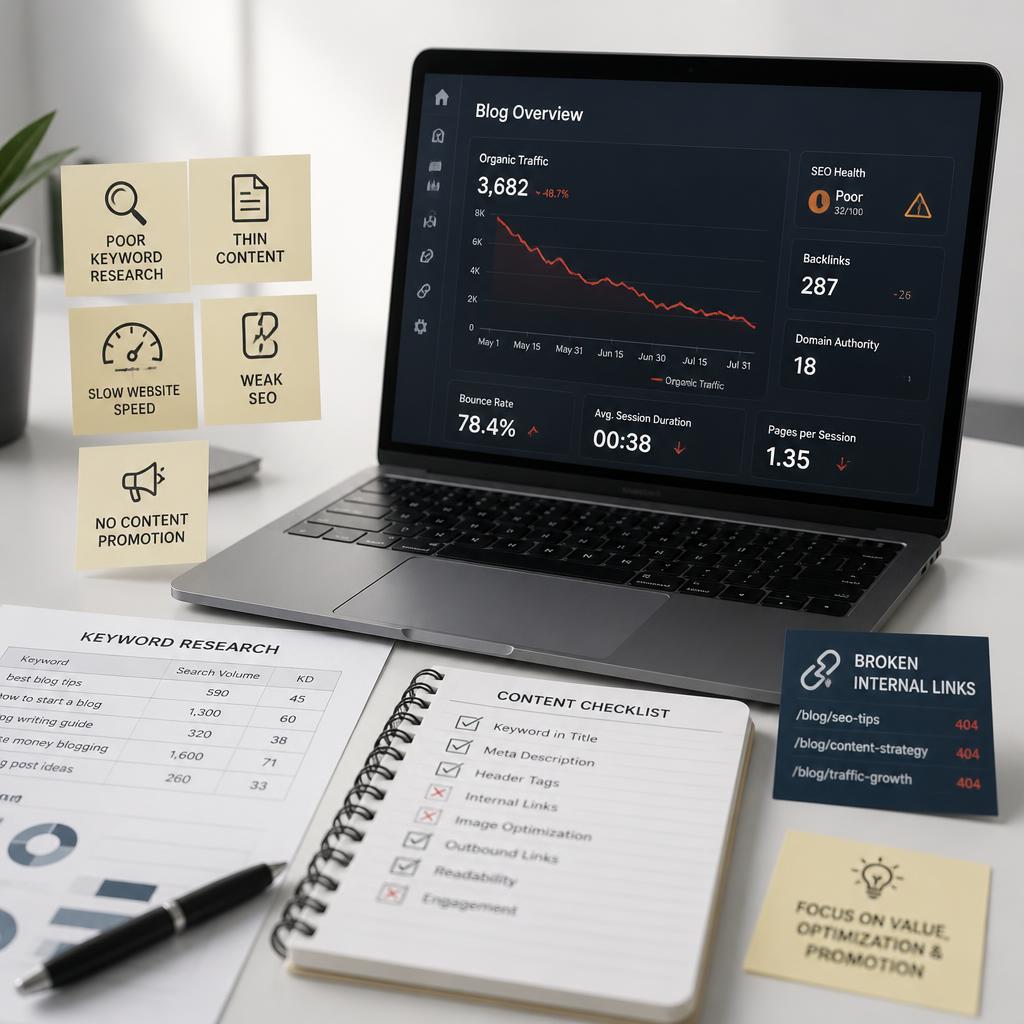
Mistake 5: Writing for Search Engines Instead of People
SEO is important, but search engines ultimately exist to serve users.
One of the biggest blogging mistakes is creating content that feels unnatural because the writer is trying to insert keywords into every paragraph.
For example:
“Looking for the best blogging tips? These blogging tips are the best blogging tips for bloggers looking for blogging tips.”
This is not useful writing.
How to Fix It
Use your primary keyword naturally.
Use related concepts and terminology where appropriate.
Instead of repeating one keyword dozens of times, explain the subject comprehensively.
For example, an article about blog traffic might naturally discuss:
- Organic search
- Keyword research
- Search intent
- Content marketing
- Internal links
- Backlinks
- On-page SEO
- Technical SEO
- Content updates
- User experience
This creates topical relevance without keyword stuffing.
Mistake 6: Keyword Stuffing
Keyword stuffing is another common SEO mistake.
Some bloggers believe that repeating the target keyword as many times as possible will improve rankings.
It usually does the opposite from a content-quality perspective.
Keyword repetition can make articles sound robotic and difficult to read.
Better Approach
Use the main keyword in important locations when natural, such as:
- Title
- Introduction
- Relevant heading
- URL
- Meta description
- Image alt text when descriptive
- Body content where appropriate
Then use natural variations throughout the article.
For example, an article targeting “blogging mistakes” might naturally include:
- Common blogging mistakes
- Blog SEO mistakes
- Mistakes bloggers make
- How to improve blog traffic
- Blogging problems
- Content marketing mistakes
- SEO mistakes that reduce traffic
The goal is clarity rather than repetition.
Mistake 7: Poor Content Structure
Even excellent information can perform poorly if it is difficult to read.
Large blocks of text discourage readers, especially on mobile devices.
A well-structured blog post should make it easy for readers to scan the page and quickly locate the information they need.
How to Structure a Blog Post
Use:
- One clear H1
- Logical H2 sections
- H3 subsections where necessary
- Short paragraphs
- Bullet points
- Numbered lists
- Tables where appropriate
- Bold text for important concepts
- Descriptive links
- Clear conclusions
For example:
H1: Common Blogging Mistakes That Hurt Traffic
H2: What Blogging Mistakes Hurt Traffic?
H2: Mistake 1: Poor Keyword Research
H2: Mistake 2: Ignoring Search Intent
H2: Mistake 3: Thin Content
H2: How to Fix Blogging Mistakes
H2: Blogging SEO Checklist
This structure helps readers navigate the article and makes the relationships between topics clearer.
Mistake 8: Writing Weak Introductions
Your introduction is one of the first things visitors see.
A common mistake is spending several paragraphs introducing the subject without answering the reader’s immediate question.
For search-focused content, a direct introduction is usually more useful.
For example:
“Blog traffic can decline for many reasons, including poor keyword targeting, weak search intent alignment, slow page speed, poor internal linking, and outdated content. The good news is that most of these problems can be identified and fixed with a systematic content audit.”
This immediately establishes:
- The problem
- The main causes
- The solution
A Simple Introduction Formula
Use:
Problem + Cause + Promise
Example:
“Many blogs struggle to attract Google traffic even after publishing dozens of articles. The problem is often not the amount of content but mistakes involving keyword research, search intent, content quality, technical SEO, and promotion. This guide explains the most common blogging mistakes and shows you how to fix them.”
Mistake 9: Ignoring Internal Links
Internal links connect pages on the same website.
They help visitors discover related information and help search engines understand relationships between pages.
Google uses links as part of discovering pages, while descriptive anchor text can provide contextual information about linked pages. SEO research also identifies internal linking as an important optimization opportunity.
How to Improve Internal Linking
Every important blog post should have relevant internal links where appropriate.
For example, an article about blogging mistakes could link to articles about:
- Technical SEO
- Keyword research
- Internal linking
- Content optimization
- Link building
- Search intent
- Content marketing
- Website speed
Use descriptive anchor text.
Instead of:
“Click here”
use:
“learn how to perform a technical SEO audit.”
The second version gives readers and search engines more context.
Mistake 10: Creating Multiple Articles About the Same Topic
Publishing several articles that target nearly identical search intent can create unnecessary competition between your own pages.
For example, a website might publish:
- Best SEO Tools
- Top SEO Tools
- SEO Tools You Need
- Best SEO Software
- Best SEO Platforms
If these articles cover essentially the same intent, the site may have a content organization problem.
Technical SEO Checklist for WordPress Sites
How to Fix It
Audit similar articles.
Determine whether they:
- Target different search intents
- Serve different audiences
- Cover distinct topics
- Have different purposes
If two articles overlap heavily, consider consolidating them into one stronger resource where appropriate.
This can also make internal linking and content maintenance easier.
Mistake 11: Slow Website Speed
Website performance affects the user experience.
Google’s page experience guidance includes Core Web Vitals among the aspects site owners should monitor, alongside mobile usability, security, intrusive interstitials, and other page experience considerations.
A slow website can create frustration before visitors even read your article.
Common Causes of Slow Blogs
These include:
- Large images
- Excessive plugins
- Poor hosting
- Unoptimized JavaScript
- Unoptimized CSS
- Too many third-party scripts
- Poor caching
- Heavy themes
- Unnecessary tracking tools
How to Improve Speed
Consider:
- Compressing images
- Using modern image formats
- Enabling browser caching
- Using a content delivery network
- Removing unnecessary plugins
- Reducing third-party scripts
- Optimizing CSS and JavaScript
- Choosing suitable hosting
Use tools such as Google PageSpeed Insights and Search Console to monitor performance.
Mistake 12: Ignoring Mobile Users
A blog that looks good on desktop but performs poorly on mobile can lose visitors.
Mobile optimization should include more than responsive design.
Check:
- Font size
- Button size
- Navigation
- Image dimensions
- Paragraph length
- Pop-ups
- Tables
- Videos
- Ads
- Page loading time
Google’s page experience guidance specifically recommends ensuring that content displays well on mobile devices.
Mobile Content Checklist
Before publishing, open the article on a smartphone.
Ask:
- Can I read the text comfortably?
- Are headings easy to scan?
- Are images displayed correctly?
- Can I click links easily?
- Does the page load quickly?
- Are intrusive pop-ups blocking the content?
Small improvements to mobile usability can make the content easier to consume.
Mistake 13: Writing Weak Titles
Your title influences whether people understand what your article is about and whether they want to click it.
A vague title can reduce click-through potential.
Compare:
“Blogging Tips”
with:
“20 Common Blogging Mistakes That Hurt Traffic and How to Fix Them”
The second title communicates:
- The topic
- The number of mistakes
- The problem
- The benefit
Tips for Better Blog Titles
A useful title should generally:
- Clearly describe the content
- Match the search intent
- Include the primary topic naturally
- Create a specific expectation
- Avoid misleading claims
- Be understandable at a glance
Do not create clickbait that promises something the article does not deliver.
Mistake 14: Ignoring Meta Titles and Meta Descriptions
A blog post can have excellent content but still miss opportunities because its search appearance is poorly optimized.
Your title tag and meta description help communicate what the page is about in search results.
A meta description is not a substitute for quality content, and Google may generate or modify search-result snippets. However, writing a clear description can help communicate the page’s subject and value.
Example
Meta Title:
Common Blogging Mistakes That Hurt Traffic | Complete Guide
Meta Description:
Discover 20 common blogging mistakes that reduce traffic, rankings, and engagement. Learn how to fix keyword, content, SEO, speed, and promotion problems.
Mistake 15: Publishing Without a Content Strategy
Random publishing can make it difficult to build topical depth.
Instead of writing unrelated articles every week, create content clusters around important subjects.
For example, an SEO website might build a cluster around technical SEO:
Pillar Topic:
Technical SEO Guide
Supporting Topics:
- Technical SEO Checklist
- XML Sitemap Best Practices
- Robots.txt Guide
- Canonical Tags Explained
- JavaScript SEO
- Website Crawlability
- Indexing Problems
- Core Web Vitals
These articles can be connected with relevant internal links.
Why Topic Clusters Help
A structured content strategy allows you to:
- Cover important topics comprehensively
- Create internal linking opportunities
- Build topical depth
- Identify content gaps
- Reduce random publishing
- Make content planning easier
Mistake 16: Publishing Too Much Low-Quality Content
More content is not automatically better.
A website publishing 20 weak articles may gain less value than a website publishing five highly useful articles.
This is especially important when using AI writing tools.
AI can help with research, outlines, brainstorming, editing, and drafting, but simply generating large quantities of generic articles does not create a strong content strategy.
Better Approach
Use AI as a productivity tool while maintaining human oversight.
Add:
- Original examples
- First-hand experience
- Unique data
- Expert commentary
- Original research
- Useful screenshots
- Practical recommendations
- Clear explanations
The goal should be to create content that provides genuine value rather than simply increasing the number of indexed pages.
Mistake 17: Ignoring Technical SEO
Sometimes the problem is not the article itself.
A technically excellent article cannot generate organic search visibility if search engines cannot properly access, crawl, or index it.
Technical problems can include:
- Accidental
noindex - Blocked crawling
- Incorrect canonical tags
- Broken links
- Server errors
- Poor redirects
- Duplicate URLs
- Sitemap problems
- Security issues
SEO audits commonly identify crawling and indexing problems as fundamental issues because search engines need access to a page before it can appear in search results.
Technical SEO Checklist
Check:
- Is the page indexable?
- Can Google crawl it?
- Does the canonical point to the correct URL?
- Is the page included appropriately in the XML sitemap?
- Does the URL return a successful status code?
- Are important internal links working?
- Are there unnecessary redirect chains?
Google Search Console is particularly useful for identifying indexing and search performance issues.
Mistake 18: Not Promoting Your Content
Publishing an article does not guarantee that people will discover it.
Search engines can eventually discover content, but promotion can help put useful information in front of relevant audiences.
Content promotion can include:
- Email newsletters
- Social media
- Industry communities
- Expert outreach
- Digital PR
- Relevant forums
- Partnerships
- Link building
- Repurposing content into videos
- Social posts
- Infographics
SEO research on increasing blog traffic commonly includes content promotion, internal linking, email, community participation, and link building as complementary traffic strategies.
Promotion should be relevant and useful rather than spammy.
Mistake 19: Ignoring Backlinks and Digital PR
Internal links help connect your own website, but external links from relevant websites can also contribute to authority and discoverability.
However, backlinks should not become an excuse to pursue low-quality or manipulative link schemes.
Instead, create assets that people genuinely want to reference.
Examples include:
- Original research
- Industry statistics
- Surveys
- Detailed guides
- Free tools
- Calculators
- Templates
- Original case studies
- Expert roundups
- Useful visual resources
You can then promote these resources to journalists, publishers, bloggers, and industry websites when they are genuinely relevant.
Mistake 20: Never Updating Old Content
Publishing an article and forgetting about it for years is a common mistake.
Industries change.
Statistics become outdated.
Tools change.
Links break.
Search intent evolves.
Competitors publish better resources.
As a result, older content may need periodic review.
SEO practitioners frequently recommend auditing and updating content based on performance, relevance, and changes in search intent.
What Should You Update?
Review:
- Statistics
- Examples
- Screenshots
- External links
- Internal links
- Outdated recommendations
- Titles
- Headings
- Search intent
- FAQs
- Images
- Meta information
Do not change the publication date simply to make an article appear fresh.
The update should reflect meaningful improvements to the content.
AEO vs GEO vs SEO: Complete Comparison 2026
GEO vs SEO: What You Need to Know in 2026
Can Google Read JavaScript? Unlocking Search Engine SEO
Mistake 21: Ignoring Content Performance Data
Another major blogging mistake is publishing articles without measuring what happens afterward.
You need data to determine which content is working and which pages need improvement.
Google Search Console can help you examine:
- Search queries
- Impressions
- Clicks
- Click-through rate
- Average position
- Indexed pages
Analytics platforms can provide additional information about:
- Organic sessions
- Engagement
- Conversions
- Landing pages
- User behavior
What to Look For
Suppose an article receives:
10,000 impressions but only 100 clicks.
That could indicate an opportunity to examine the title, search intent, or search-result presentation.
Another article may receive:
500 clicks but generate no conversions.
In that case, the problem may not be traffic. The content may need a clearer next step or better alignment with the user’s needs.
Mistake 22: Focusing Only on Traffic
Traffic is useful, but traffic alone does not define whether a blog is successful.
Imagine two articles:
Article A receives 10,000 visitors but almost none become customers.
Article B receives 1,000 visitors and generates 30 qualified leads.
Depending on the website’s goal, the second article may have greater business value.
That is why you should measure multiple outcomes.
Important metrics may include:
- Organic traffic
- Search impressions
- Click-through rate
- Engagement
- Email signups
- Leads
- Sales
- Affiliate clicks
- Revenue
- Assisted conversions
The right metric depends on the purpose of the website.
Mistake 23: Using Generic AI-Generated Content
AI has changed how quickly bloggers can produce content.
But speed can create a new problem: large quantities of generic articles that provide little differentiation.
Common signs include:
- Repetitive explanations
- Generic introductions
- Predictable sections
- No original examples
- No evidence
- No first-hand experience
- Excessive repetition
- Vague recommendations
AI can be useful for brainstorming, outlining, summarizing research, and improving drafts.
However, the final content should still be accurate, useful, specific, and appropriate for the audience.
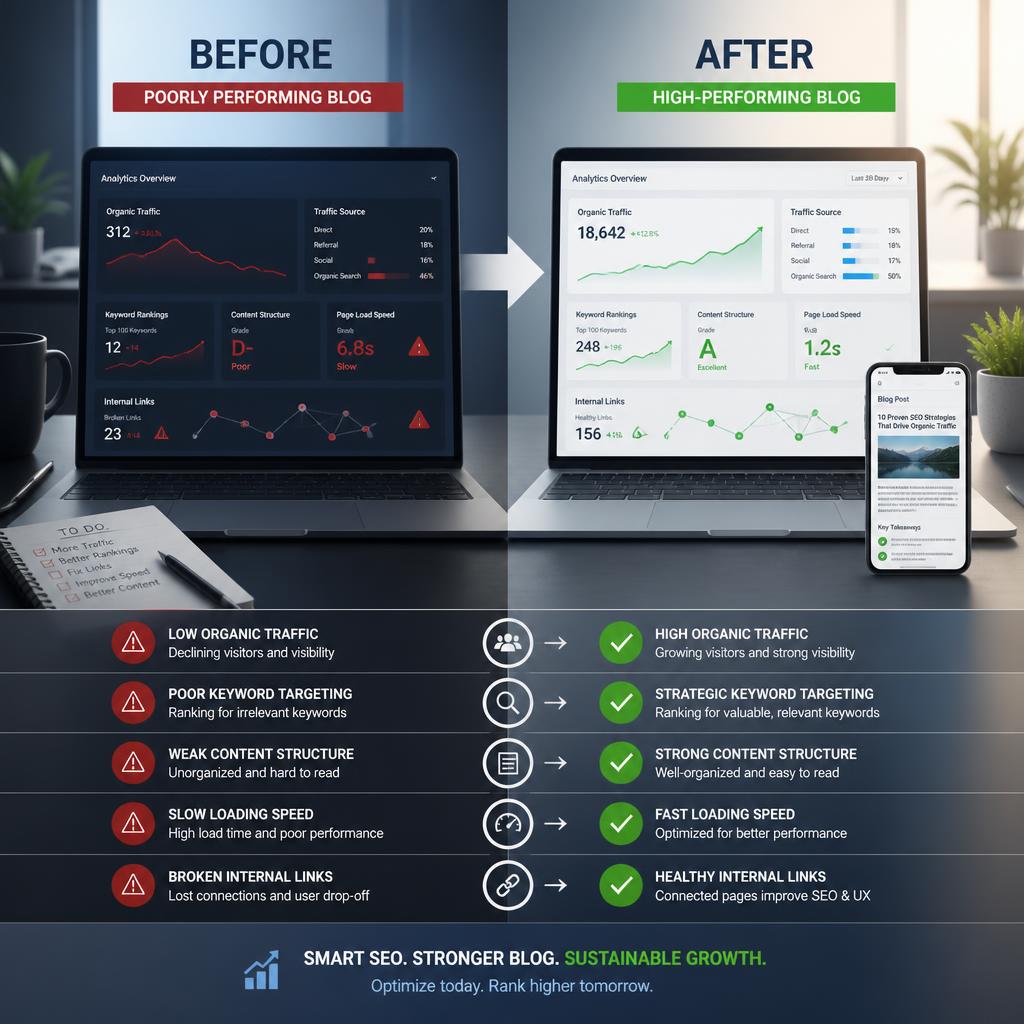
How to Improve AI-Assisted Articles
Add information that cannot be easily generated from generic sources:
- Your own experience
- Original screenshots
- Real examples
- Data
- Case studies
- Expert interviews
- Unique comparisons
- Original analysis
The objective is not to hide AI use. The objective is to make the final resource genuinely useful.
Mistake 24: Ignoring User Experience
SEO and user experience should not be treated as completely separate.
A visitor should be able to arrive at your article and quickly understand:
- What the page is about
- Whether it answers their question
- Where to find specific information
- What to do next
Google’s page experience guidance encourages website owners to consider the overall experience, including mobile usability, Core Web Vitals, security, intrusive elements, and the ability to distinguish the main content.
Improve Blog UX By:
- Using readable typography
- Keeping navigation simple
- Avoiding excessive pop-ups
- Limiting distracting advertisements
- Improving page speed
- Adding useful navigation
- Using descriptive headings
- Making important information easy to find
- Providing clear calls to action
Mistake 25: Not Building Topic Authority
A blog can publish hundreds of unrelated posts without becoming strongly associated with any particular subject.
Instead, consider developing depth around the topics that matter most to your audience.
For example, a website focused on digital marketing might create comprehensive clusters covering:
- SEO
- Content marketing
- Link building
- Technical SEO
- AI search
- Digital PR
- Keyword research
Each cluster can contain a central guide supported by detailed articles.
This makes the website more useful to visitors and creates opportunities for contextual internal linking.
How to Audit Your Blog for Traffic-Killing Mistakes
If your blog is already established, you do not need to start from scratch.
Perform a content audit.
Step 1: Export Your Pages
Create a list of your blog URLs.
For each page, record:
- URL
- Topic
- Primary keyword
- Organic traffic
- Impressions
- Clicks
- Rankings
- Conversions
- Publication date
- Last updated date
- Number of internal links
Step 2: Identify Underperforming Pages
Look for pages with:
- High impressions but low clicks
- Rankings without meaningful traffic
- Declining traffic
- No impressions
- No conversions
- Outdated information
- Weak internal links
Step 3: Classify Each Page
You can categorize pages as:
Keep: The article performs well and remains useful.
Improve: The topic is valuable but the page needs optimization.
Consolidate: Several pages overlap and could potentially be combined.
Redirect: The page has little value and a relevant replacement exists.
Remove: The page has no useful purpose and should not remain simply for the sake of having more content.
Make these decisions based on the specific site and URL rather than applying one rule to every article.
A Practical Blog SEO Checklist
Before publishing a new article, review the following checklist.
Keyword Research
- Is there evidence of search demand?
- Is the topic relevant to your audience?
- Have you identified a primary keyword?
- Have you researched related terms?
- Have you analyzed competing results?
Search Intent
- Do you understand why people search for the keyword?
- Does your content format match the query?
- Does the article answer the main question quickly?
- Does it address related questions?
Content Quality
- Does the article provide genuine value?
- Is the information accurate?
- Does it contain useful examples?
- Does it offer something beyond generic information?
- Have unnecessary filler sections been removed?
On-Page SEO
- Is the title descriptive?
- Is there one clear H1?
- Are H2 and H3 headings logically organized?
- Is the URL descriptive?
- Is the meta description compelling?
- Are images optimized?
- Are internal links included?
Technical SEO
- Can search engines crawl the page?
- Is the page indexable?
- Is the canonical URL correct?
- Is the page returning a successful status code?
- Is it appropriately represented in the XML sitemap?
User Experience
- Does the page work well on mobile?
- Does it load quickly?
- Is the content easy to scan?
- Are advertisements and pop-ups controlled?
- Can users easily find the information they need?
After Publishing
- Was the article promoted?
- Was it linked from relevant older articles?
- Is performance being monitored?
- Will the content be reviewed again later?
How Long Does It Take for a Blog to Get Traffic?
There is no universal timeframe for a new blog post to rank or generate significant traffic.
Results can depend on:
- Website authority
- Competition
- Search demand
- Content quality
- Search intent
- Internal links
- External links
- Technical SEO
- Topic selection
- Website history
- Search engine crawling and indexing
Some pages may receive search visibility relatively quickly, while others can take considerably longer.
Therefore, avoid judging an article solely a few days after publication.
Monitor performance over time and look for trends.
Why Is My Blog Getting No Traffic?
If your blog receives little or no organic traffic, investigate the problem systematically.
Possible causes include:
- The topics have little search demand.
- The keywords are extremely competitive.
- Search intent does not match the content.
- The content provides insufficient value.
- The site has technical SEO problems.
- Important pages are not indexed.
- Internal linking is weak.
- The website is new and has limited authority.
- Content is outdated.
- Articles are not promoted.
- Several pages compete for the same intent.
- Titles do not accurately communicate the content.
Do not immediately assume that you simply need to publish more articles.
First identify the actual bottleneck.
How to Increase Blog Traffic Without Publishing More Articles
You can often improve an existing blog without dramatically increasing publishing volume.
Start by optimizing existing assets.
1. Improve Existing Articles
Update outdated information and expand sections that do not fully answer the query.
2. Improve Search Intent Alignment
Review the current search results and determine whether your content matches what users are looking for.
3. Add Internal Links
Link important pages from relevant articles.
4. Improve Titles
Make titles clearer and more descriptive.
5. Fix Technical Problems
Resolve indexing, crawlability, speed, and mobile usability issues.
6. Build Relevant Backlinks
Promote useful resources and pursue legitimate editorial opportunities.
7. Consolidate Overlapping Content
Combine competing articles where doing so creates a stronger resource.
8. Refresh Outdated Content
Update statistics, examples, links, screenshots, and recommendations.
These actions can sometimes produce more value than publishing another batch of low-quality articles.
What is technical SEO vs on-page SEO?
How to Create a Blog Content Strategy That Avoids These Mistakes
A strong content strategy can prevent many blogging problems before they occur.
Start by defining:
Your Audience
Who are you trying to help?
Their Problems
What questions do they have?
Their Search Behavior
What do they search for?
Your Expertise
What subjects can your website cover credibly?
Your Business Goals
Do you want:
- Traffic?
- Leads?
- Sales?
- Affiliate clicks?
- Brand awareness?
- Email subscribers?
Then create content that connects audience needs with business objectives.
A Simple 30-Day Blogging Improvement Plan
If your blog currently has traffic problems, use a structured process.
Week 1: Research
Audit:
- Keywords
- Search intent
- Existing rankings
- Search Console data
- Technical SEO
- Content overlap
Identify your highest-priority problems.
Week 2: Content Optimization
Choose several important articles and improve:
- Titles
- Introductions
- Headings
- Search intent alignment
- Content depth
- Internal links
- FAQs
- Images
Week 3: Technical and UX Improvements
Check:
- Mobile usability
- Page speed
- Core Web Vitals
- Indexing
- Canonicals
- Sitemap
- Broken links
- Intrusive elements
Google recommends considering page experience as an overall combination of factors rather than focusing on one isolated metric.
Week 4: Promotion and Measurement
Promote your best content through relevant channels.
Then monitor:
- Impressions
- Clicks
- Rankings
- Organic traffic
- Engagement
- Conversions
Use the results to determine what should be improved next.
Frequently Asked Questions About Blogging Mistakes
What is the biggest blogging mistake?
There is no single mistake that causes every blog to lose traffic. Common problems include poor keyword research, mismatched search intent, weak content, technical SEO problems, poor internal linking, slow pages, and outdated content.
Why are my blog posts not getting traffic?
Blog posts may receive little traffic because they target topics with limited search demand, fail to match search intent, face strong competition, have technical SEO problems, or do not provide enough value. Analyze search demand, search intent, indexing, content quality, and competition before deciding what to change.
Does longer content rank better?
Not automatically. A longer article can be useful when the topic requires detailed coverage, but word count by itself does not guarantee better rankings. Focus on satisfying the user’s needs rather than reaching an arbitrary word count.
How many blog posts should I publish per week?
There is no universal publishing frequency that guarantees SEO success. A realistic schedule that allows you to consistently produce useful, accurate content is generally more sustainable than publishing large amounts of low-quality material.
Does keyword stuffing help SEO?
Keyword stuffing is not a sound SEO strategy. Use relevant keywords naturally and focus on explaining the subject clearly.
Are internal links important for SEO?
Yes. Relevant internal links can help users navigate a website and help search engines discover and understand relationships between pages.
Should I update old blog posts?
Yes, when the information, search intent, or usefulness of the article has changed. Updates should provide meaningful improvements rather than simply changing the date.
Can AI-written content rank in Google?
The use of AI does not automatically determine whether content will perform well. The important consideration is whether the resulting content is useful, accurate, relevant, and created for people rather than merely produced to manipulate search rankings. AI can be used as part of a content workflow, but human review and meaningful value remain important.
How do I know if my blog content is successful?
Measure results that correspond to your goals. These may include organic traffic, impressions, clicks, rankings, engagement, leads, sales, affiliate clicks, email signups, or revenue.
Should every blog post target a keyword?
Every search-focused article should have a clear topic and audience need. Keyword research can help validate the topic and discover how people search for it, but the article should not be written around an unnatural keyword repetition strategy.
Final Thoughts: How to Avoid Blogging Mistakes That Hurt Traffic
Blog traffic rarely depends on one magic SEO technique.
Successful blogging is usually the result of many small decisions working together.
You need to choose topics people care about, understand search intent, create useful content, structure articles clearly, build relevant internal links, maintain a technically accessible website, optimize the mobile experience, promote valuable resources, and update important content over time.
The most important lesson is simple:
Do not create content just to publish more pages. Create content to solve real problems for specific audiences.
Before publishing a new article, ask:
- Does anyone need this information?
- Is there evidence that people search for this topic?
- What is the searcher’s intent?
- Does this article answer the question better or more completely?
- Is the information accurate and useful?
- Can visitors easily read and navigate the page?
- Can search engines crawl and index it?
- Have I connected it to relevant content on my website?
- How will I measure its performance?
- When will I review and update it?
These questions create a stronger foundation for sustainable blogging.
Instead of chasing a specific word count, publishing as frequently as possible, or repeating keywords throughout an article, focus on relevance, usefulness, clarity, technical accessibility, and continuous improvement.
A blog that consistently solves real problems has a much stronger foundation for attracting search traffic and building long-term audience value.